
Cadre Restructure.pdf


Part-II
Comprehensive Report of the Committee on Cadre Restructuring of PA/SA, LSG, HSG-II, and HSG-I posts in the Post Offices (POs), Railway Mail Service Offices (RMS) and Circle/Regional Offices
Shri. G Natarajan (Member-I) Postmaster General, Chennai City Region, Tamilnadu Circle | Ms. Kaiya Arora (Member-II) Director Postal Services, Mumbai Region, Maharashtra Circle |
|---|
K Prakash
(Chairperson)
Chief Postmaster General,
Karnataka Circle
2
Table of Contents
Table of Contents................................................................................................................ 3 Table of Figures .................................................................................................................. 6 List of Tables....................................................................................................................... 7 Acknowledgement .............................................................................................................. 9 CHAPTER-1 ....................................................................................................................... 11 Introduction....................................................................................................................... 11
1.1 Background and Objective of the Cadre Restructuring Proposal ............................. 11 1.1.1 Background of the Department of Posts.............................................. 11 1.1.2 Evolution of Cadre Restructuring for PA/SA Cadres in the Department12 1.1.3 Formation of the Committee................................................................ 13 1.1.4 Objectives of the Committee ............................................................... 13 1.1.5 Terms of Reference (ToR) of the Committee....................................... 14
1.2 Methodology............................................................................................................ 15 1.2.1 Data Collection from the Circles .......................................................... 15 1.2.2 Stakeholder Representations .............................................................. 15 1.2.3 Consultations with Stakeholder Groups............................................... 16 1.2.4 Independent Study and Committee Deliberations ............................... 16
1.3 Structure of the Report ............................................................................................ 16 CHAPTER-2 ....................................................................................................................... 19 Study of Previous Committee Reports............................................................................ 19
2.1 Shri. V.P. Singh Committee Report (2014) .............................................................. 19 2.2 Implementation of Cadre Restructuring in Postal Side (2016).................................. 21 2.3 Review Committee on Cadre Restructuring (2017).................................................. 22 2.4 Shri. Charles Lobo Committee Report (2019–2021)................................................ 23
CHAPTER-3 ....................................................................................................................... 25 Summary of the Committee’s Internal Meetings............................................................. 25 3.1 First meeting of Committee Members (13.06.2025)................................................. 25 3.2 Second meeting of Committee Members (25.07.2025)............................................ 26 3.3 Third meeting of Committee Members (16.09.2025)................................................ 27 3.4 Study Visit to various offices (16.09.2025)............................................................... 28 3.5 Fourth meeting of Committee Members (16.10.2025) .................................. 29 3.6 Concluding Summary .............................................................................................. 29 CHAPTER-4 ....................................................................................................................... 31 Summary of Stakeholder Representations ..................................................................... 31 4.1 Representations from AIPAOE................................................................................ 32 4.2 Representations from AIRMS.................................................................................. 34 4.3 Representations from BPAOEU .............................................................................. 37 4.4 Representations from BPEF.................................................................................... 40 4.5 Representations from BPRASA............................................................................... 42
3
4.6 Representations from BRME................................................................................... 45 4.7 Representations from FNPO ................................................................................... 46 4.8 Representations from NAPE.................................................................................... 47 4.9 Representations from NURC................................................................................... 49 4.10 Representation from Shri. H M Raju ...................................................................... 55 4.11 Conclusion ............................................................................................................ 56
Summary of Stakeholder Consultations ......................................................................... 57 5.1 First Meeting with Staff Associations/Unions – Directorate, New Delhi .................... 57 5.1.1 Proceedings of the Meeting................................................................. 58 5.2 Second Meeting with Staff Associations/Unions – Circle Office, Karnataka Circle... 59 5.2.1 Proceedings of the Meeting................................................................. 59 5.3 Conclusion .................................................................................................... 61 CHAPTER-6 ....................................................................................................................... 63 Data Analysis and Research ............................................................................................ 63 6.1 DoPT Cadre Review Guidelines for Group ‘C’ Employees/Posts............................. 64 6.2 DoPT Guidelines/Instructions on Non-Functional Grades (NFG)............................. 67 6.3 DoPT Guidelines/Instructions on Inter-se Seniority.................................................. 68 6.4 DoPT Guidelines on Minimum Qualifying Service for Promotion ............................. 70 6.4.1 Key Principles: .................................................................................... 70 6.4.2 Norms of Qualifying Service:............................................................... 70 6.4.3 Implications for Cadre Restructuring ................................................... 71 6.4.4 Conclusion .......................................................................................... 71 6.5 DoE Guidelines on Creation, Abolition, Upgradation and Downgradation of Posts .. 72 6.5.1 Core Principles.................................................................................... 72 6.5.2 Creation of Posts ................................................................................ 72 6.5.3 Abolition of Posts ................................................................................ 73 6.5.4 Upgradation of Posts........................................................................... 73 6.5.5 Downgrading of Posts ......................................................................... 73 6.5.6 Applicability to Group ‘B’ and Group ‘C’ Cadres .................................. 74 6.5.7 Conclusion .......................................................................................... 74 6.6 Establishment Norms in Circle Office, Post Offices and Mail offices ........................ 75 6.7 Recruitment Rules – Postal Assistants (PA) & Sorting Assistants (SA) ................... 76 6.8 Recruitment Rules – HSG-I, HSG-II & LSG Grades ................................................ 77
6.8.1 Higher Selection Grade-I in Post Offices & Railway Mail Service offices ................................................................................................................................ 77 6.8.2 Higher Selection Grade-II in Post Offices, Railway Mail Service Offices and Circle Offices/ Regional Offices ........................................................................ 78 6.8.3 Lower Selection Grade in Post Offices, Railway Mail Service Offices and Circle Offices/ Regional Offices ........................................................................ 79 6.9 Study of Framework of Roles, Activities and Competencies for the PA and SA Cadres .......................................................................................................................... 80 6.9.1 FRAC for Postal Assistant (PO) .......................................................... 81
4
6.9.2 FRAC for Sorting Assistant (RMS) ...................................................... 87 6.9.3 FRAC for Postal Assistant (Circle Office/Regional Office) ................... 89 6.9.4 FRAC for LSG (Postal Side)................................................................ 93 6.9.5 FRAC for LSG (RMS Side).................................................................. 96 6.9.6 FRAC for LSG (CO/RO Side).............................................................. 99 6.9.7 FRAC for HSG-II (Higher Selection Grade-II).................................... 102 6.9.8 FRAC for HSG-I (Higher Selection Grade-I)...................................... 106 6.9.9 Comparative Analysis of Roles of PA/SA, LSG, HSG-II and HSG-I
Across Postal, RMS and CO/RO Sides ................................................................. 110 6.10 Overview of Data Analysis – Postal, RMS and CO/RO Offices............................ 113 6.10.1 Current Distribution of Grades among Cadres:................................ 114 6.10.2 Data Analysis: Postal Side .............................................................. 116 6.10.3 Data Analysis: RMS Side ................................................................ 124 6.10.4 Data Analysis: Admin (CO/RO) Side ............................................... 133 6.11 Current Work-Description of supervisors in RMS Offices..................................... 142 CHAPTER-7 ..................................................................................................................... 145 Observations of the Committee ..................................................................................... 145 7.1 Overall Structural Context ..................................................................................... 145 7.2 Pyramidal Structure and Cadre Distribution........................................................... 145 7.3 Stagnation and Career Progression....................................................................... 145 7.4 Functional Realities and Technological Transformation......................................... 146 7.5 Inter-Stream Parity and Functional Distinctiveness................................................ 146 7.6 Cross-Cadre Mobility and Convergence ................................................................ 146 7.7 Financial and Administrative Prudence.................................................................. 147 7.8 Motivation, Capacity, and Organisational Readiness............................................. 147 7.9 Concluding Observation ........................................................................................ 147 CHAPTER-8 ..................................................................................................................... 149 Recommendations of the Committee ............................................................................ 149 8.1 Merger of Postal Assistant and Sorting Assistant Cadres ...................................... 149
8.2 Rationalising Supervisory Grades Strength to 31.58% of Unified cadre & Identification of Supervisory Posts:.............................................................................. 151 8.3 Restructuring the Unified Cadre and its Grades:.................................................... 154 8.4 Recruitment & Training in Unified Cadre:............................................................... 156 8.5 Promotion & Training in Supervisory Grades:........................................................ 157 8.6 Fixing Inter-se Seniority:........................................................................................ 159 8.7 Redesigning the Work Norms for Supervisory Grades .......................................... 160
5
Table of Figures
Figure 1. Structure of the Report ................................................................................... 17 Figure 2. Career Progression Pathways in Department of Posts ................................... 21 Figure 3. Current Supervisory Strength viz. Total Cadre Strength ............................... 114 Figure 4. Staff Strength in various Grades across Admin (CO/RO), RMS, Postal Sides
.................................................................................................................................... 115 Figure 5. Circle-wise PA Cadre Pyramid in Postal Side............................................... 117 Figure 6. Circle-wise SA Cadre Pyramid in RMS......................................................... 125 Figure 7. Working Strength vs Vacancy across grades in RMS Offices....................... 131 Figure 8. Circle-wise PA-CO/RO Cadre Pyramid in Circle/Regional Offices ................ 134 Figure 9. Working Strength vs Vacancy across grades in Admin (CO/RO) Offices...... 140 Figure 10. Depiction of Posts Distribution Before and After Restructuring- Postal Side 155 Figure 11. Depiction of Posts Distribution Before and After Restructuring- RMS Side . 155 Figure 12. Depiction of Posts Distribution Before and After Restructuring- CO/RO Side
.................................................................................................................................... 155 Figure 13. Depiction of Posts Distribution Before and After Merger+Restructuring- Total (Postal + RMS + CO/RO) ............................................................................................ 155
6
List of Tables
Table 1. TBOP/BCR/MACP Schemes ........................................................................... 20 Table 2. Comparison Table: TBOP/BCR/MACP Schemes ............................................ 20 Table 3. Key Observations and Recommendations by Shri. Charles Lobo Committee .. 24 Table 4. Representations submitted by Staff Associations/Unions and other Stakeholders ...................................................................................................................................... 31 Table 5. Minimum service norms for Promotion -DoPT ................................................. 70 Table 6. Recruitment Rules of PA/SA Entry Grades in PO, RMS and CO/RO Offices ... 76 Table 7. Recruitment Rules for HSG-I in Post Offices ................................................... 77 Table 8. Recruitment Rules for HSG-I in Railway Mail Service Offices.......................... 77 Table 9. Recruitment Rules for HSG-I in Circle/Regional Offices................................... 77 Table 10. Recruitment Rules for HSG-II in Post Offices ................................................ 78 Table 11. Recruitment Rules for HSG-II in Railway Mail Service Offices....................... 78 Table 12. Recruitment Rules for HSG-II in Circle/Regional Offices................................ 78 Table 13. Recruitment Rules for LSG in Post Offices .................................................... 79 Table 14. Recruitment Rules for LSG in Railway Mail Service Offices........................... 79 Table 15. Recruitment Rules for LSG in Circle/Regional Offices ................................... 79 Table 16. Current Distribution of Staff among various grades of PA, SA Cadres of Post
Offices, Railway Mail Service Offices & Circle/Regional Offices .................................. 114 Table 17. Share of Cadre Strength across Postal, RMS and Admin (CO/RO Sides) ... 114 Table 18. Sanctioned Posts in PA Cadre of Post Offices............................................. 116 Table 19. Working Strength Posts in PA Cadre of Post Offices ................................... 118 Table 20. Comparative Table in POs (PA Cadre) – Type of Offices, Sanctioned Strength, Working Strength, Supervisory Ratios, and Percentage .............................................. 119 Table 21. Number of Officials in Different Pay Levels -Postal Side.............................. 120 Table 22. Gradewise Number of Officials in Different Pay Levels -Postal Side............ 121 Table 23. Vacancy Position in Postal Side .................................................................. 122 Table 24. Vacancy profile in Postal Side ..................................................................... 123 Table 25. Posts Vacant for more than 5 years in Postal Side ...................................... 123 Table 26. Sanctioned Posts in SA Cadre of RMS........................................................ 124 Table 27. Working Strength Posts in SA Cadre of RMS .............................................. 126 Table 28. Comparative Table in RMS (SA Cadre) – Type of Offices, Sanctioned
Strength, Working Strength, Supervisory Ratios, and Percentage............................... 127 Table 29. Number of Officials in Different Pay Levels -RMS Side................................ 128 Table 30. Gradewise Number of Officials in Different Pay Levels -RMS Side.............. 129 Table 31. Vacancy Position in RMS Side .................................................................... 130 Table 32. Vacancy profile in RMS Side ....................................................................... 131 Table 33. Posts Vacant for more than 5 years in RMS Side ........................................ 132 Table 34. Sanctioned Posts in PA Cadre of CO/RO Offices ........................................ 133 Table 35. Working Strength Posts in PA Cadre of CO/RO Offices............................... 135 Table 36. Comparative Table in CO/RO (PA Cadre) – Number of Offices, SS, WS,

Supervisory Ratios, and Percentages ......................................................................... 136 Table 37. Number of Officials in Different Pay Levels -CO/RO Side............................ 137 Table 38. Gradewise Number of Officials in Different Pay Levels -CO/RO Side .......... 138 Table 39. Vacancy Position in CO/RO Side................................................................. 139 Table 40. Vacancy profile in CO/RO units ................................................................... 140 Table 41. Posts Vacant for more than 5 years in CO/RO Side .................................... 141 Table 42. Stagnation profile in Postal, RMS and CO/RO Side..................................... 141 Table 43. Proposed Work Norms for Supervisory Posts.............................................. 160
7
Acknowledgement
At the outset, I wish to place on record my deep sense of gratitude to the Establishment and Personnel Divisions of the Postal Directorate for entrusting me with the responsibility to chair this important and comprehensive exercise on Cadre Restructuring of PA/SA, LSG, HSG-II and HSG-I posts. Their confidence, guidance and encouragement have been a constant source of motivation in undertaking this significant assignment on behalf of the Department.
I am sincerely thankful to all the Members of the Committee (Shri. G Natarajan, PMG, Chennai City Region, Taminadu Circle & Ms. Kaiya Arora, DPS, Mumbai region, Maharashtra Circle) for their valuable insights, active participation, and constructive contributions throughout the course of our deliberations. Their collective experience and balanced perspectives have greatly enriched the analysis and recommendations presented in this report.
I also wish to place on record my appreciation for the Co-opted Members (Shri. Chandrakantha Kamath, APMG (Staff), Circle Office, Karnataka Circle, Shri. T Ramasudhakara Rao, AD-III, Bengaluru HQ Regional Office, Karnataka Circle, Ms. C S Preethi, ASP (Estb.) and Shri. J Mohan, ASP (Vig.), Circle Office, Karnataka Circle) whose technical knowledge, field experience and close coordination with the Directorate, Circles and Staff Associations have been of immense help to the Committee. Their contribution in gathering data, validating information, and assisting in the compilation of this report deserves special mention.

I gratefully acknowledge the cooperation of the representatives of the Staff Associations and Unions, who not only submitted detailed representations but also participated in the Committee’s discussions with sincerity and constructive spirit. Their views and suggestions have provided valuable insights into the operational realities and expectations of the workforce, which have been duly considered in the formulation of this report.
Finally, I wish to record my appreciation for the dedicated efforts of the officers and staff who assisted the Committee in data compilation, research, documentation and report preparation.
It is my earnest hope that the findings and recommendations contained in this report will assist the Department in shaping a more efficient, equitable and functionally robust cadre structure—one that not only addresses existing gaps but also aligns with the evolving needs of a modern, technology-driven postal ecosystem, thereby strengthening the professional excellence and service quality of India Post.
K Prakash
(Chairperson)
Chief Postmaster General,
Karnataka Circle
9
CHAPTER-1
Introduction
1.1 Background and Objective of the Cadre Restructuring Proposal
1.1.1 Background of the Department of Posts
The Department of Posts (India Post), under the Ministry of Communications, is one of the largest and oldest government organizations in India. Today, it operates the largest postal network in the world with 1,64,987 post offices, nearly 90% of which are in the rural areas. For administrative purposes, the network is divided into 23 Postal Circles and 54 Regions, further subdivided into Postal and Railway Mail Service (RMS) Divisions1.
India Post’s mission is to remain the most accessible and trusted public service platform, delivering mail and parcel services, financial products through POSB, PLI and RPLI, and new-age banking solutions via the India Post Payments Bank (IPPB). It also plays a key role in Direct Benefit Transfer (DBT), disbursing social security payments, MGNREGA wages, and other government schemes even in the remotest areas.
In recent years, the Department has undertaken major IT modernization projects, including Core Banking and Parcel Network Optimization, which have enhanced efficiency and widened service scope. Yet, the expanding functional domains have also highlighted challenges in cadre structure, particularly in maintaining operational efficiency while ensuring career progression.
Within this vast network, the Department manages a Railway Mail Service (RMS) setup of 69 Divisions and nearly 400 operational units such as Mail Offices, HROs/SROs, and Parcel Hubs, which form the backbone of mail and parcel transmission. Similarly, the 23 Circle Offices and 54 Regional Offices serve as key administrative and policy coordination centres. With technology-driven operations and the growth of e-commerce and DBT responsibilities, the scale and complexity of work in RMS and CO/RO has expanded considerably, underscoring the need for a more robust supervisory framework.
1 Annual Report- 2024-25 (Department of Posts)
10
1.1.2 Evolution of Cadre Restructuring for PA/SA Cadres in the Department
The Cadre restructuring in the Department of Posts has been a long-standing policy exercise, aimed at balancing functional requirements with the legitimate career aspirations of employees.
The earlier efforts, such as the Shri V. P. Singh Committee (2014)2, highlighted the disproportionate ratio between operative and supervisory staff (87% operative vs. 13% supervisory) and recommended a revised 65% operative and 35% supervisory structure to address stagnation and limited promotional opportunities. Based on these recommendations, cadre restructuring was implemented for Postal Assistants in 20163.
However, when the same framework was extended to the Railway Mail Service (RMS), Savings Bank Control Organisation (SBCO), and Circle/Regional Offices (CO/RO), the Department of Expenditure (DoE) sought detailed functional justifications for each proposed upgradation. Despite repeated references, approval was withheld in the absence of adequate justification.
Given its vast network and expanding portfolio, the Department increasingly relies on RMS units and CO/RO offices for core mail operations, administrative coordination, technology adoption, and implementation of government programmes. Yet, the cadre composition in these units has remained heavily weighted towards operative posts, with limited supervisory strength. This imbalance has led to stagnation in promotions, uneven distribution of responsibilities and functional gaps— necessitating a comprehensive restructuring exercise to align supervisory posts with present-day operational and administrative needs.
To address this gap, successive Committees—including the Charles Lobo Committee (2019–2021)4—were tasked with providing functional justifications specific to RMS, SBCO, and CO/RO cadres, taking into account IT modernization, expansion of parcel business, and DBT handling as new and evolving challenges.
2 Shri. V P Singh Committee Report (2014) - No. 17-49/2014-GDS dated 27.08.2014 3Implementation of Cadre Restructuring in Postal Side - No.25-04/2012-P.E.I dated 27.05.2016 4 Report of the Committee constituted to workout the functional justification and make recommendation for the utilization of the posts which have been proposed to be created by upgradation in LSG, HSG-II, HSG-I & HSG-I (NFG) Grades in RMS, SBCO and CO/RO
11
1.1.3 Formation of the Committee
Recognising the persisting need for cadre restructuring and the requirement of DoE for detailed justifications, the Department of Posts constituted a fresh Cadre Restructuring Committee vide Office Order No. Q-25/18/2025-PE-I-DOP dated 03.06.20255, later reconstituted on 12.06.20256, then again on 15.07.20257.
The revised composition of the Committee is as follows:
1. Shri K. Prakash, Chief Postmaster General, Karnataka Circle (Chairperson)
2. Shri G. Natarajan, Postmaster General, Chennai City Region, Tamil Nadu Circle (Member)
3. Ms. Kaiya Arora, DPS, Mumbai Region, Maharashtra Circle (Member) The Committee has also been empowered to co-opt additional officers as required to support its work. The Committee has since held multiple meetings with participation from the Directorate, staff associations, and field formations.
1.1.4 Objectives of the Committee
The objectives of the present cadre restructuring exercise are:
I. Restructuring and review of cadres – To undertake a composite cadre review and propose restructuring in the Postal Assistants/Sorting Assistants (PA/SA), Lower Selection Grade (LSG), Higher Selection Grade-II (HSG-II), and Higher Selection Grade-I (HSG-I) posts in Postal, RMS and Circle/Regional Offices in line with functional requirements and future needs.
II. Pyramidal structure – To evolve a clear and pyramidal structure that ensures functional efficiency at each level and adequate promotional avenues, maintaining a suitable ratio between feeder and promotional grades.
III. Functional justification – To provide functional justification for supervisory posts in emerging and specialized areas such as Parcel Hubs, BNPL/BPC centres, Integrated Delivery Centres (IDCs), Mails Marketing roles, and IT enabled monitoring functions.
IV. Safeguarding feeder cadres – To ensure that restructuring does not adversely affect the strength and promotional prospects of feeder cadres.
V. Financial viability – To assess the financial implications realistically and link them with efficiency gains, improved supervision, and better service quality.
5 Genesis of the CRC Committee (2025): Q-25/18/2025-PE-I-DOP dated 03.06.2025 6 First Reconstitution of CRC Committee: Q-25/18/2025-PE-I-DOP dated 12.06.2025 7 Final Reconstitution of CRC Committee: Q-25/18/2025-PE-I-DOP dated 15.07.2025
12
VI. Policy compliance – To align proposals with guidelines of Department of Personnel & Training (DoPT) and Department of Expenditure (DoE).
1.1.5 Terms of Reference (ToR) of the Committee
As per the Directorate’s initial letter dated 03.06.20258, the Committee’s Terms of Reference are:
I. Study the existing structure of PA/SA, LSG, HSG-II & HSG-I posts of Railway Mail Service (RMS) and Circle/Regional Offices.
II. Make Recommendation for Cadre Restructuring of PA/SA, LSG, HSG-II & HSG-I posts of Railway Mail Service (RMS) and Circle/Regional Offices in accordance with the guidelines issued by DoPT/ Department of Expenditure on the subject.
The committee was given three months to submit its report/recommendations to the Member (Personnel) within a period of 3 months.
Subsequently, the Terms of Reference were revised vide directorate letter dated 21.08.20259, and the Committee was tasked to undertake a Composite Cadre Review of PA/SA, LSG, HSG-II and HSG-I grades in Post Offices (PO), Railway Mail Service (RMS), and Circle/Regional Offices (CO/RO). The revised Terms of Reference are as follows:
I. Study the existing structure and job description of PA/SA, LSG, HSG-II & HSG I posts in Post Offices, Railway Mail Service and Circle/ Regional Offices.
II. Make Recommendation for Cadre Restructuring of PA/SA, LSG, HSG-II & HSG-I grades in Post Offices, Railway Mail Service, Circle/ Regional Offices, in accordance with the guidelines issued by the DoPT/ Department of Expenditure on the subject.
An extension of one month, beyond the originally stipulated period of three months, was granted to the Committee for submitting its report with recommendations to the Directorate.
The Committee vide letters dated 30.09.202510 & 15.10.202511 have sought additional time till 27.10.2025 for submitting its recommendations.
8 Q-25/18/2025-PE-I-DOP dated 03.06.2025
9 Q-25/18/2025-PE-I-DOP dated 21.08.2025
10 ESA/9-144/CadreRestructuringCommittee/2025 dated 30.09.2025
11 ESA/9-144/CadreRestructuringCommittee/2025 dated 15.10.2025
13
1.2 Methodology
The Committee adopted a data-driven and consultative approach in formulating its recommendations. Detailed cadre-wise data on sanctioned strength, vacancies, stagnation, workload, and functional requirements was collected from Circles and analysed systematically to ensure evidence-based proposals. Alongside, the Committee engaged in structured consultations with Directorate divisions, field officers, and recognized staff unions/associations and field units to incorporate diverse perspectives and ensure that the restructuring exercise is both functionally sound and broadly acceptable.
The approach also factored in multiple dimensions of the Department’s evolving environment—including large-scale IT modernisation, expansion of parcel and logistics business, and the growing role of India Post in financial inclusion and government service delivery. Importantly, the changing profile of new recruits, particularly Postal Assistants/Sorting Assistants (PAs/SAs) under the revised Recruitment Rules of 2022, was considered. With a minimum entry requirement of a bachelor’s degree, the incoming workforce is more technologically proficient and adaptable to new business and operational challenges. The methodology therefore emphasised aligning supervisory structures not only with present workloads but also with the future-readiness of the Department in a competitive environment.
1.2.1 Data Collection from the Circles
As part of this exercise, the Committee, through the Establishment Division of the Directorate, initiated a systematic data collection process covering RMS units and Circle/Regional Offices (CO/RO). This exercise sought to capture correlations between the number and type of offices, sanctioned strength, working strength, vacancies, and stagnation profiles of officials. By analysing these parameters together, the Committee aimed to identify structural imbalances, assess promotional bottlenecks, and understand the distribution of supervisory roles across different functional units. This evidence base is intended to guide objective recommendations for cadre restructuring that are both functionally justified and aligned with long-term organisational requirements.
1.2.2 Stakeholder Representations
The Committee recognised the importance of incorporating the perspectives of staff side representatives and associations in the restructuring exercise. Accordingly, representations received from various stakeholder organisations were carefully examined. These submissions were studied, analysed, and deliberated upon by the Committee members and co-opted officers, with due consideration given to both the functional justification and the career aspirations highlighted therein. The inputs received through this process have been factored into the Committee’s approach, ensuring that the recommendations reflect a balanced view of organisational requirements and staff concerns.
14
1.2.3 Consultations with Stakeholder Groups
In addition to written representations, the Committee, in coordination with the Directorate, has held direct consultations with stakeholder groups including staff unions and associations. These interactions, conducted in physical mode, provided an opportunity to understand first-hand the perspectives, apprehensions, ideas, proposals, and grievances of the staff side. Such engagements allowed the Committee to clarify doubts, explain the objectives of the restructuring exercise, and capture field
level realities that may not be reflected in data alone. The inputs gathered through these consultations form an important part of the deliberative process and will contribute to ensuring that the final recommendations are both practical and broadly acceptable.
1.2.4 Independent Study and Committee Deliberations
Alongside data collection and stakeholder consultations, the members of the Committee undertook independent research and study, followed by detailed deliberations during Committee meetings. Several meetings, including through virtual mode, were convened to examine the issues from both the departmental perspective and the staff perspective. The members reviewed previous committee reports, studied the roles of Postal Assistants, Sorting Assistants, LSG and HSG officials in RMS and CO/RO administrative offices, and analysed the earlier cadre restructuring of Postal Assistants on the Postal side. The Committee also deliberated upon various ratios of supervisory to operative staff, taking into account workload patterns, type of office, and nature of duties involved. These discussions provided a well-rounded basis for developing balanced and functionally justified recommendations.
1.3 Structure of the Report
For clarity and ease of reference, the Report of the Committee has been organised into the following sections:
I. Study of Previous Cadre Restructuring Proposals – reviewing earlier Cadre Restructuring exercises such as the Shri. V. P. Singh Committee (2014), the restructuring implemented for Postal Assistants in 2016, and subsequent reviews including the review by Shri. Charles Lobo Committee (2019–21).
II. Summary of the Committee’s Internal Meetings – providing an account of the discussions and deliberations held among members and co-opted members.
III. Summary of Stakeholder Representations – outlining the key points received from various unions, associations, and other stakeholders through written submissions.
15
IV. Summary of Stakeholder Consultations – capturing the views, suggestions, and concerns expressed during direct consultations with staff associations and unions.
V. Data Analysis and Research – presenting the analysis of data collected from Circles on RMS and CO/RO offices, along with other relevant studies and past committee reports.
VI. Final Observations of the Committee – highlighting the consolidated findings and perspectives emerging from the Committee’s examination.
VII. Recommendations of the Committee – setting out the Committee’s proposed framework for cadre restructuring, based on functional justification, data analysis, and stakeholder feedback.
Figure 1. Structure of the Report
16
This page has been left blank
17
CHAPTER-2
Study of Previous Committee Reports
2.1 Shri. V.P. Singh Committee Report (2014)12
A Committee under Shri. V P Singh was constituted to examine the cadre restructuring of Group ‘C’ employees in the Department of Posts. The Committee studied the TBOP and BCR promotional schemes, as well as the subsequent Modified Assured Career Progression Scheme (MACPs), and reviewed the pay structures introduced under the 6th Central Pay Commission. It defined the attributes of an ideal cadre, emphasising balanced promotional avenues, functional efficiency, and uniformity across categories .
The Committee also examined norms for calculation of supervisory posts in Post Offices and RMS, classification of offices, recruitment rules, and anomalies in promotional hierarchies. In its deliberations, it consulted the staff side on demands such as nomenclature changes, upgradation of certain posts, creation of new supervisory positions, and proposals for separate cadres for System Administrators, Marketing Executives, and PO & RMS Accountants, as well as the merger of four Group B posts on the officers’ side. Each of these demands was carefully analysed, with the Committee recording its observations and recommendations .
Ultimately, the Committee recommended a revised cadre ratio of 65% operative posts and 35% supervisory posts, in place of the prevailing 87:13 ratio, to reduce stagnation and improve promotional opportunities. It further advised that the Establishment Division of the Directorate work out detailed supervisory-to-operative ratios for RMS, SBCO, and CO/RO cadres. These recommendations were accepted and implemented on the Postal side in 2016, but their extension to RMS, SBCO, and CO/RO was held up at the Department of Expenditure for want of functional justification.
| TBOP (1983) | 1st upgradation at 16 years. |
|---|---|
| BCR (1991) | 2nd upgradation at 26 years. |
| MACP (2008) | Universal scheme across Govt, replacing TBOP/BCR, with 3 upgradations at 10, 20, 30 years. |
12 Establishment Division Letter No. 17-49/2014-GDS dated 27.08.2014
18
| TBOP/BCR/MACP Schemes |
|---|
| 1. TBOP (Time Bound One Promotion) ● Introduced: 30.11.1983 (specific to Department of Posts). ● Purpose: To address stagnation in promotions for Postal Assistants/Sorting Assistants (PAs/SAs) and other Group-C cadres. ● Provision: Officials who completed 16 years of regular service without getting a promotion were granted one financial upgradation to the next higher grade (without change in designation). ● Nature: Considered a financial promotion but counted as regular promotion at the time. |
| 2. BCR (Biennial Cadre Review) ● Introduced: 01.10.1991 (again in DoP for Group-C cadres). ● Purpose: To further reduce stagnation beyond TBOP. ● Provision: Officials who completed 26 years of regular service (and already availed TBOP at 16 years) were granted a second financial upgradation. ● Nature: Like TBOP, it was originally treated as promotion, not just financial upgradation. |
3. MACP (Modified Assured Career Progression Scheme)
● Introduced: 01.09.2008 (after the 6th Central Pay Commission).
● Applies to: All Central Government employees (including DoP), replacing TBOP and BCR.
● Provision: Ensures 3 financial upgradations in an employee’s career if regular promotions are not received:
○ 1st MACP after 10 years of regular service,
○ 2nd MACP after 20 years,
○ 3rd MACP after 30 years.
● Nature: Purely financial upgradations to the next Grade Pay (later Pay Matrix Level under 7th CPC); does not count as regular promotion.
Table 1. TBOP/BCR/MACP Schemes
Scheme | TBOP (Time Bound One Promotion) | BCR (Biennial Cadre Review) | MACP (Modified Assured Career Progression) |
|---|---|---|---|
Introduced | 30.11.1983 (DoP specific) | 01.10.1991 (DoP specific) | 01.09.2008 (6th CPC, all CG employees) |
Eligibility / Service Condition | After 16 years of regular service without promotion | After 26 years of regular service (post-TBOP) | 10, 20, and 30 years of regular service (if no promotion received) |
No. of Upgradations | 1st (at 16 years) | 2nd upgradation (at 26 years) | 3 upgradations (10 → 20 → 30 years) |
Nature | Treated as promotion (not just financial) | Also treated as promotion | Financial upgradation only (not a promotion) |
Applicability
Postal Assistants / Sorting Assistants and other Group-C cadres
Postal Assistants / Sorting Assistants and other Group-C cadres
All Central Government employees, including DoP
Table 2. Comparison Table: TBOP/BCR/MACP Schemes
19
Figure 2. Career Progression Pathways in Department of Posts
2.2 Implementation of Cadre Restructuring in Postal Side (2016)13
Following the recommendations of the Shri V. P. Singh Committee (2014), cadre restructuring was implemented in the Postal side w.e.f. May 2016 for Postal Assistants and supervisory cadres (LSG, HSG-II, HSG-I). The implementation sought to address promotion stagnation and align the cadre ratio closer to the 65:35 operative-to-supervisory benchmark.
Key features of implementation included:
I. Creation of new supervisory posts in LSG, HSG-II, and HSG-I to provide higher promotional avenues to PAs.
II. Reclassification of Post Offices based on workload norms, resulting in upgradation of a large number of single and double-handed offices into LSG posts.
III. Strengthening of HSG-II and HSG-I by earmarking them for bigger offices (Head POs, large Sub-Offices, and RMS units where applicable). IV. Introduction of Non-Functional Higher Grade (NFHG) in HSG-I, enabling time-bound placement for officials stagnating at the top supervisory level.
V. Revised cadre ratios: operative posts (PAs) reduced and supervisory posts increased, in line with the 65:35 principle.
The restructuring provided immediate promotional relief to a large number of Postal Assistants, many of whom had remained in the same grade for decades. It also
13 PE-I Section (Directorate) Letter No. 25-04/2012-P.E.I dated 27.05.2016
20
created a clearer career ladder within the Postal side, ensuring that the supervisory chain of LSG → HSG-II → HSG-I was functionally staffed.
However, the implementation was confined only to the Postal wing, while similar restructuring proposals for RMS, SBCO, and CO/RO were held back by the Department of Expenditure pending detailed functional justification. This divergence created an imbalance, with the Postal side benefiting from promotional avenues, while stagnation continued in the other wings.
2.3 Review Committee on Cadre Restructuring (2017)14
Subsequent to the implementation of cadre restructuring in the Postal side in 2016, a number of Circles faced difficulties and sought clarifications on various aspects of the orders—such as norms for identifying upgraded LSG posts, distribution of posts across Divisions, fixation of Leave Reserve strength, and operation of Non
Functional Grade (NFG) in HSG-I. To address these issues, the Directorate constituted a Review Committee vide Office Order No. 25-04/2012-PE-I dated 09 June 2017, under the chairmanship of Shri Charles Lobo, CPMG, Karnataka Circle, with Ms. Smriti Sharan, DDG (Estt.), Shri J.T. Venkateswarlu, PMG (Mails & BD), Chennai, and Shri Ganesh V. Sawaleshwarkar, PMG, Pune Region, as members.
The Review Committee was mandated to examine the implementation challenges and propose uniform procedures for applying the 2016 cadre restructuring orders across Circles. After detailed consultations, including discussions with staff representatives, the Committee submitted its report on 22 September 2017. Based on its recommendations, the Directorate issued comprehensive implementation instructions vide letter dated 10 November 2017.
Key features of the accepted recommendations included:
I. Uniform identification of upgraded posts: All SPM posts in B- and C class offices were to be upgraded to LSG; A-class and norm-based LSG offices to HSG-II; and surplus LSG posts distributed as per functional requirements.
II. Clarification on special categories: Treasurer, System Administrator, Marketing Executive, and PLI Development Officer posts were not treated as cadre-specific. Foreign Post staff (except Mumbai FP) were covered under restructuring, while RLO staff were excluded.
III. LSG cadre structure: The Committee recommended that the LSG should remain a Circle cadre, avoiding divisionalisation that could lead to disparities in promotional opportunities between divisions.
14 Constitution of Committee to review the Cadre Restructuring orders of Postal Group ‘C’ Employees - No.25-04/2012-PE-I dated 09.06.2017
21
IV. Identification of HSG-I (NFG) posts: Only 10 percent of HSG-I posts were approved for placement in the NFG scale. Until formal identification, Circles could extend NFG benefits temporarily based on seniority.
V. Leave Reserve strength: LR strength was to be recalculated based on the combined PA and LSG posts, recognising that many LSG officials would continue to perform operative duties.
VI. Date of effect: Promotions under restructuring were to be effective retrospectively from 27 May 2016, the date of the original orders.
The 2017 Review Committee thus played a crucial role in standardising the application of the 2016 restructuring orders, ensuring consistency across Circles, and laying the foundation for later functional reviews—culminating in the 2019–2021 Committee’s more comprehensive study on RMS, SBCO, and CO/RO cadres.
2.4 Shri. Charles Lobo Committee Report (2019–2021)15
To address the gaps left after cadre restructuring was implemented in the Postal side (2016) but held back in RMS, SBCO, and CO/RO, the Department constituted the Committee under the chairmanship of Shri Charles Lobo, then Member (Operations). The Committee was tasked with providing functional justification for cadre restructuring in these segments, in line with the Department of Expenditure’s directions.
Key areas studied by the Committee included:
I. Functional roles in RMS, SBCO, and CO/RO: Mapping duties of Sorting Assistants, Supervisors (LSG/HSG-II/HSG-I), and administrative staff to justify the need for supervisory posts.
II. Workload and operational changes: Impact of declining letter-mail volumes, rise of parcel and logistics business, and IT-driven processes in RMS offices.
III. Stagnation profiles: Analysis of career progression bottlenecks for officials in RMS and CO/RO, highlighting lack of promotional avenues compared to Postal side counterparts.
IV. Recruitment Rules (RRs): Examination of the Recruitment Rules for all the cadres and its grades.
15 Report of the Committee constituted to workout the functional justification and make recommendation for the utilization of the posts which have been proposed to be created by upgradation in LSG, HSG-II, HSG-I & HSG-I (NFG) Grades in RMS, SBCO and CO/RO
22
V. Staff-side representations: Considered demands for creation of new roles (e.g., System Administrators, Marketing Executives, Accountants) etc.,
Recommendations and Observations:
I. Recognised the need to rationalise cadre ratios for RMS and CO/RO on the same lines as the Postal side, while factoring in differences in functional roles.
II. Stressed functional justification for each supervisory post, linked to workload in mail offices, hubs, and administrative units.
III. Recommended protection of feeder cadres (PAs/SAs) to avoid weakening the operational base while creating supervisory positions. IV. Suggested strengthening of supervisory posts in parcel hubs, BNPL/BPCs, and new business verticals to meet modernisation and market demands.
V. Emphasised the importance of career growth parity between Postal and RMS/CO/RO staff, noting growing discontent due to imbalance.
While the Charles Lobo Committee provided detailed inputs, its proposals required further refinement to fully satisfy the Department of Expenditure’s criteria. Consequently, the matter was kept pending, eventually leading to the constitution of the present CRC Committee (2025) to consolidate data, consult stakeholders afresh, and prepare a comprehensive, functionally justified proposal.
Issue Studied Observations Recommendations | ||
|---|---|---|
Cadre imbalance in RMS & CO/RO | The postal side benefited from CR (2016), but RMS/CO/RO stagnation persisted. | Extend restructuring to RMS & CO/RO with balanced cadre ratios. |
Workload & operational changes | Decline in letter-mail, rise in parcels/logistics, IT-driven operations in RMS offices. | Create supervisory posts in parcel hubs, BNPL/BPCs, and digital units. |
Stagnation profiles | Officials lacked promotional avenues compared to the Postal side. | Align promotional avenues with the Postal side to maintain parity. |
Recruitment Rules (2022) | Entry cadre upgraded (Bachelor’s degree minimum); workforce more tech-savvy. | Structure posts to leverage skills of new entrants and meet modernisation needs. |
Staff-side representations | Demands for new cadres (System Admin, MEs, Accountants). | Consider functional roles carefully; protect feeder cadres while rationalising posts. |
Table 3. Key Observations and Recommendations by Shri. Charles Lobo Committee
23
CHAPTER-3
Summary of the Committee’s Internal Meetings
The Committee on Cadre Restructuring of PA/SA, LSG, HSG-II and HSG-I cadres in RMS and CO/RO has held multiple meetings since its constitution in June 2025. These meetings were conducted in both physical and virtual mode and provided a platform for members to review past proposals, examine present requirements, and chart a structured methodology for preparing recommendations. The deliberations focused on striking a balance between functional justification, promotional avenues for staff, and organisational efficiency.
3.1 First meeting of Committee Members (13.06.2025)16
The inaugural meeting of the Committee was held on 13 June 2025 in hybrid (virtual and physical) mode under the chairmanship of the Chief Postmaster General, Karnataka Circle. The meeting marked the formal commencement of the Committee’s work.
Key highlights:
I. The Committee reviewed its Terms of Reference and noted the three month timeline for submission of recommendations.
II. It was recorded that the Committee was empowered to co-opt officers for support; accordingly, the following officers were co-opted:
A. Shri. Chandrakantha Kamath, APMG (Staff), O/o Chief Postmaster General, Karnataka Circle;
B. Shri. T Ramasudhakara Rao, AD-III, O/o PMG, Bengaluru HQ Region;
C. Ms. C S Preethi, ASP (Estb.(, O/o Chief Postmaster General, Karnataka Circle;
D. Shri. Mohan J, ASP(Vig), O/o Chief Postmaster General, Karnataka Circle
III. A Coordination Cell at the Circle Office, Bengaluru was established to assist the Committee in data collection and correspond with the Directorate.
IV. The Committee resolved to adopt a data-driven methodology, covering sanctioned and working strength, vacancy position, stagnation profile, pay levels, and promotion timelines.
V. The importance of functional justification for every supervisory post was underscored, in line with DoE requirements.
16 Minutes of First CRC Committee Meeting: 13-06-2025
24
VI. It was agreed to study previous reports (V. P. Singh and Charles Lobo Committees) and incorporate learnings.
VII. The Committee identified the need for office-level work studies in both high-volume (Parcel Hubs, NSHs, FPOs) and low-volume (L2 Hubs, smaller RMS units) establishments to validate role structures.
VIII. Consultations with staff associations and unions were considered essential to capture the staff perspective alongside departmental needs. This meeting essentially mapped out the Committee’s approach: a blend of data analysis, functional assessment, stakeholder consultation, and field validation.
3.2 Second meeting of Committee Members (25.07.2025)17
The second meeting was held on 25 July 2025, also in hybrid mode, to review progress and deliberate on emerging issues.
Key highlights:
I. The Committee noted the reconstitution of membership vide Directorate’s order dated 15.07.2025.
II. Representations from staff associations and unions were reviewed; it was decided these would be categorised, analysed, and deliberated upon in detail in subsequent sittings.
III. Focus was placed on ensuring parity with the Postal side, where cadre restructuring had been implemented in 2016, and on reducing disparities in promotional avenues between RMS/CO/RO and Postal staff.
IV. The Committee examined the role and distribution of Sorting Assistants, and discussed strengthening supervisory cadres in RMS and CO/RO to match functional requirements.
V. Specific emphasis was given to supervisory needs in BNPL Centres, Business Post Centres, Integrated Delivery Centres (IDC), and Parcel operations.
VI. The idea of creating a common cadre from LSG upwards was discussed to ensure uniformity, efficiency, and smoother progression.
VII. It was agreed to conduct structured consultations at Dak Bhawan, engaging Directorate divisions and staff associations.
VIII. Additional issues such as the designation of Senior Sorting Assistants, cross-functional deployment, and use of officials in marketing and IT related roles were flagged for further study.
This meeting marked a transition from broad planning in the first session to issue-specific deliberations and review of stakeholder inputs.
17 Minutes of Second CRC Committee Meeting: 25-07-2025
25
3.3 Third meeting of Committee Members (16.09.2025)18
The third meeting of the Committee on Comprehensive Cadre Review/Restructuring of PA/SA, LSG, HSG-II & HSG-I posts in Post Offices, Railway Mail Service (RMS) Offices, and Circle/Regional Offices was held on 16.09.2025 in physical mode at the Office of the Chief Postmaster General, Karnataka Circle. The meeting was chaired by the Chief Postmaster General, Karnataka Circle, and attended by Committee Members and Co-opted Members. The deliberations focused on reviewing functional structures, addressing cadre stagnation, and exploring structural and operational reforms to ensure balanced promotional avenues and organisational efficiency across all streams.
Key highlights:
I. Review of Representations: The Committee acknowledged and discussed the representations submitted by various unions and associations, focusing on inter-cadre disparities, stagnation in RMS and CO/RO cadres, and parity in promotional avenues.
II. Functional Justification & Work Description: Members stressed the importance of defining work descriptions for each category to provide a functional basis for any proposed restructuring or post enhancement.
III. Sensitive Roles: The Committee noted the need to highlight sensitive duties such as UPSC/NEET examination handling, cash management, Bulk Customer operations, and control functions in RMS, MMS, and CO/ROs while determining supervisory requirements.
IV. Norms and Guidelines: DoPT’s Non-Functional Grade (NFG) guidelines and potential one-time RR relaxations were identified for further detailed examination to address stagnation and anomalies.
V. Structural Observations: Postal side shows around 34% supervisory strength; no major increase required but feeder-grade ratios to be rationalized (suggested ratio 1:3:9:27). RMS and CO/RO sides face significant pyramid distortions and long-pending vacancies.
VI. Service-Related Issues: Financial disincentives on promotion and MACP loss risks were noted. Mission Karmayogi was recognized as a potential enabler for developing a unified competency framework across clerical cadres.
VII. Emerging Functional Needs: The Committee acknowledged the evolving business and IT-enabled environment (IDCs, DDD, NDD) requiring redefined duties and cross-functional capabilities.
VIII. Cadre Merger Concept: A possible “Associate Cadre” merger model was discussed to enable parity, mobility, and cross-functional exposure, replacing mere hierarchical upgradation.
18 Minutes of Third CRC Committee Meeting: 16-09-2025
26
IX. Supervisory Ratio Proposals: Indicative ratios discussed—RMS: 16.66% and CO/RO: 20%—subject to validation through functional study.
X. Recruitment & Training Reforms: The need for a unified recruitment framework, common training, and seniority norms was emphasized if merger or restructuring proposals are implemented.
XI. Financial Implication: It was further agreed that any recommendations proposed should conform to Department of Expenditure (DoE) guidelines and should not entail significant additional financial implications for the Department.
XII. Next Steps: Committee to continue data analysis, conduct field visits, validate functional studies, and draft recommendations within the prescribed timeline.
3.4 Study Visit to various offices (16.09.2025)
The Chairperson, along with co-opted members, undertook a study visit on 08.10.2025 to the NSH-Bengaluru, TMO, BNPL Centre, IDC, and Bengaluru GPO located within the Bengaluru GPO building. The objective of the visit was to examine the business processes, manpower distribution, operational requirements, and the nature of supervisory work in these offices.
Key highlights:
I. In NSH and TMOs, the core function pertains to sorting and connecting bags for transmission lines, which operate in multiple sets. These units already experience considerable workload pressure due to manpower shortages. While the need for supervision is evident, it was felt that an excessive increase in supervisory posts may not be necessary. Instead, supervisory mechanisms should be streamlined to ensure timely sorting and connection of articles to their destination routes.
II. In IDCs, it was noted that officials and supervisors from the RMS side could also be effectively utilized given their experience and expertise in sorting operations.
III. At the BNPL Centre, effective supervision and regular follow-up with major customers were found to be essential for ensuring timely invoicing, prompt dispatch of bags to Mail Offices, and overall service efficiency.
IV. In the Post Office visited, the existing supervisory strength was found to be adequate and functionally balanced.
V. The Committee also noted that supervisory posts across these units should be assigned a defined operational component in addition to their supervisory duties, as pure supervisory roles without hands-on operational involvement appear less effective in the current functional context.
27
3.5 Fourth meeting of Committee Members (16.10.2025)19
The fourth meeting of the Committee on Comprehensive Cadre Review/Restructuring of PA/SA, LSG, HSG-II & HSG-I posts in Post Offices, Railway Mail Service (RMS) Offices, and Circle/Regional Offices was held on 16.10.2025 in hybrid mode at the Office of the Chief Postmaster General, Karnataka Circle. The meeting, chaired by the Chief Postmaster General, Karnataka Circle, was convened to finalise the Committee’s recommendations following a comprehensive review of cadre structures across Postal, RMS, and CO/RO streams.
The deliberations of the Committee culminated in a set of final recommendations, which are presented in detail in Chapter 8 of this report.
3.6 Concluding Summary
Since its constitution in June 2025, the Committee adopted a systematic and consultative approach to cadre restructuring across RMS and CO/RO establishments. Through successive meetings, it evolved from defining the scope and methodology to addressing field realities and inter-cadre parity. A data-driven and functionally grounded approach—combining analysis of sanctioned strength, vacancies, and promotion patterns with insights from field inspections and stakeholder consultations—ensured that the recommendations were both evidence-based and practical.
Recurring themes included balancing supervisory strength with workload, introducing operational components in supervisory roles, rationalising feeder-grade ratios, and ensuring parity with the Postal side. The Bengaluru field study at NSH, TMO, BNPL Centre, IDC, and GPO reinforced these findings, highlighting the need for optimal supervisory deployment, stronger accountability, and integration of RMS experience into new functional units. These efforts laid a sound foundation for final recommendations that are functionally justified, financially sustainable, and structurally coherent across all streams.
19 Minutes of Fourth CRC Committee Meeting: 16-10-2025
28
This page has been left blank
29
CHAPTER-4
Summary of Stakeholder
Representations
In the course of the present Cadre Restructuring exercise, wide-ranging representations were received from National Level Unions, Federations, Associations, and also from individual employees. Prominent among them were the All India Postal Administrative Offices Employees Union (AIPAOE), All India RMS & MMS Employees Union (AIRMS), Bharatiya Postal Administrative Offices Employees Union (BPAOEU), Bharatiya Postal Employees Federation (BPEF), Bharatiya Postal RMS Administrative Staff Association (BPRASA), Bharatiya RMS Employees Union (BRME), National Association of Postal Employees (NAPE), and the National Union of RMS & MMS Employees (NURC). In addition, Shri H. M. Raju, an individual employee, also submitted his views. Several of these organisations furnished multiple memoranda at different stages of consultation, highlighting functional requirements, issues of stagnation, parity across cadres, and promotional avenues. These diverse submissions formed an important source of input for the Committee, ensuring that the voices of both organised staff bodies and individual officials were taken into account in shaping the recommendations.
| Union/ Individual | Representations | ||
|---|---|---|---|
| AIPAOE | 19-08-2025 | 25-09-2025 | |
| AIRMS | 19-08-2025 | 14-09-2025 | |
| BPAOEU | 22-08-2025 | 16-09-2025 | 21-10-2025 |
| BPEF | 17-09-2025 | ||
| BPRASA | 12-07-2025 | 17-09-2025 | 22-09-2025 |
| BRME | - | 16-09-2025 | |
| FNPO | 22-10-2025 | ||
| NAPE | - | 16-09-2025 | |
| NURC | 19-08-2025, 19-09- 2025 | 06-10-2025, 10-10- 2025 | 11-10-2025, 19-10- 2025 |
| Shri. H M Raju | 26-08-2025 |
Table 4. Representations submitted by Staff Associations/Unions and other Stakeholders
30
4.1 Representations from AIPAOE
The All India Postal Administrative Offices Employees Union (Group C including MTS), representing officials of Circle and Regional Offices (CO/RO) and DPLI, Kolkata, submitted a detailed memorandum dated 19.08.2025 to the Committee. The representation comprehensively dealt with issues of stagnation, functional imbalance, and parity with the Postal Assistant (Post Office) cadre, whose cadre restructuring had been implemented in 2017.
The Union emphasised that while both PA(PO) and PA(CO/RO) cadres were recruited through a common process with identical qualifications, the administrative side continues to face decades of stagnation and limited promotional avenues. The memorandum urged the Committee to extend cadre restructuring benefits to PA(CO/RO) cadres retrospectively from the same date as that of the Postal side (2017), ensuring equal treatment in pay structure and career progression.
Summary of Key Points Raised (Letter dated 19.08.202520 – CO/RO Cadres)
I. Parity with PA(PO): Requested same date of implementation as the 2017 Postal side restructuring to ensure equal treatment.
II. Nomenclature & Entry Pay: Suggested renaming PA(CO/RO/DPLI) as Administrative Assistant and upgrading entry pay to Level-5.
III. Revised Structure: Proposed five levels — Administrative Assistant (L 5), Sr. Administrative Assistant/Administrative Supervisor (L-6), Sr. Administrative Supervisor (L-7), Section Officer/Dy.OS/OS (L-8), and AD(Rectt) (L-9).
IV. Supervisory Ratio: Highlighted that only about 12% of posts are supervisory; proposed increasing this to achieve a ratio of about 1:4.5.
V. Functional Roles: Recommended inclusion of DPLI, creation of Level 9 AD(Rectt) posts in each Circle, and recognition of specialised functions like System Manager and Marketing Executive.
VI. One-time Relaxation: Requested one-time promotion relaxation to fill all upgraded posts and remove stagnation.
VII. Prayer: To approve the proposed restructuring ensuring parity with the Postal side, include DPLI cadres, and rationalise administrative structures in CO/RO for improved functional efficiency.
20 AIPAOE Representation dated 19.08.2025
31
Summary of Key Points Raised (Letter dated 25.09.202521 – CO/RO Cadres)
I. Retrospective Implementation: Requested that cadre restructuring for PA(CO/RO) be implemented from the same date as that of PA(PO) (2016-17) to ensure parity.
II. Inclusion of DPLI, Kolkata: Sought inclusion of PA, LSG, and HSG cadres of DPLI Office, Kolkata under the restructuring proposal.
III. Nomenclature & Pay Upgradation: Proposed renaming PA(CO/RO/DPLI) as Administrative Assistant with entry pay upgraded to Level-5 in view of graduate-level recruitment through SSC.
IV. Revised Structure: Suggested a reorganised hierarchy — Administrative Assistant (L-5), Administrative Supervisor (L-6), Sr. Administrative Supervisor (L-7), Section Officer / Dy.OS / OS (L-8), and Assistant Director (L-9) — with enhanced supervisory ratio and clear promotional pathways.
V. Functional Enhancements: Recommended creating specialised posts such as System Manager, Marketing Executive, and DO(PLI) in each CO/RO; and upgrading existing AD(Rectt) posts to AD (Welfare/Sports/DDO) at Level-9, with one additional AD post per Circle.
VI. Promotion Policy: Proposed reduced qualifying service (5-3-2-1 years across levels) and a one-time relaxation to fill all upgraded posts to remove stagnation.
VII. Other Suggestions: The representation also highlighted stagnation in the existing structure and sought parity in career progression with other central administrative cadres. It proposed extending the same restructuring benefits to DPLI cadres and creating certain specialised functional posts to strengthen administrative efficiency. The Union further opposed linking the cadre restructuring process with any transfer policy.
VIII. Prayer: To approve the proposed restructuring with upgraded hierarchy and pay levels, include DPLI cadres, and implement parity with the Postal side from the same effective date.
21 AIPAOE Representation dated 25.09.2025
32
4.2 Representations from AIRMS
The All India RMS & MMS Employees Union (AIRMS), representing Sorting Assistants, RMS Supervisors and MMS staff, made two submissions to the Committee as part of the ongoing cadre restructuring consultations. The first, dated 19.08.2025, placed detailed proposals for restructuring of Sorting Assistants and supervisory cadres in RMS, drawing parallels with the benefits already extended to Postal Assistants in 2016. The second, dated 14.09.2025, supplemented the earlier memorandum with specific suggestions on the MMS cadre and the Store Officers cadre, highlighting the need for equal treatment, wider promotional avenues, and revised recruitment rules. Through both representations, the Union strongly emphasised parity between Postal and RMS/MMS cadres, the creation of structured supervisory posts, reduction in stagnation, and recognition of emerging functional requirements like System Administrators and Marketing Executives.
Summary of Key Points Raised (Letter dated 19.08.202522 – RMS Cadres)
I. Parity with Postal Assistants: Demanded that the same cadre restructuring benefits given to Postal Assistants in 2016 be extended to Sorting Assistants with effect from the same date, ensuring equal promotional benefits.
II. Creation of Supervisory Posts:
A. LSG: In sets with up to 5 Sorting Assistants, one LSG (NB) Supervisor should be created.
B. HSG-II: In sets with 5–10 SAs, one HSG-II Supervisor and one LSG Supervisor should be created.
C. HSG-I: In sets with 10 or more SAs, one HSG-I Supervisor post should be created.
III. Functional Allocation of Supervisory Cadres:
A. LSG: Independent MSAs in mail offices, Pay bill OA, control room OA, cashier in MMS divisions, Senior most AMAs in major TMOs, and In-charges of District Bag Offices.
B. HSG-II: Supervisors of all L1 offices, administration supervisors in MMS divisions, section in-charges in mail offices, and OAs in divisional accounts.
22 AIRMS Representation dated 19.08.2025
33
C. HSG-I: HSAs of L1/L2 offices, Managers/HSAs of NSH, PBC/PPC, BPUs, PIIs, CCRCs, CMAs of major TMOs, and all HROs.
IV. Relaxation of Rules: Requested one-time relaxation of qualifying service for promotions to HSG-II and HSG-I, citing long stagnation.
V. Non-Functional Upgradation (NFG): Sought that HSG-I officials in GP 4600 (Level 7) be granted GP 4800 (Level 8) on a non-functional basis after 2 years, to be termed as HSG-I NFG.
VI. Accountant Cadre: Demanded upgradation of PA (Accounts) to LSG, LSG Accounts to HSG-II, and at least 20% of HSG-II Accounts to HSG I, to create a proper promotional channel for Accountant-qualified officials.
VII. System Administrators: Proposed redeployment of vacant SA posts utilized for IT duties as sanctioned System Administrator posts with 15% special allowance; alternatively, create separate sanctioned posts of System Administrators in RMS/Postal.
VIII. Marketing Executives: Supported Department’s move to create a separate Marketing Executive cadre and requested allocation of such posts in RMS.
IX. Superintendent Sorting: Noted only 4 posts (Delhi, Mumbai, Kolkata, Chennai) exist; requested creation of 4 additional posts in other metro cities (Ahmedabad, Bengaluru, Hyderabad, Pune) due to heavy mail volumes.
Summary of Key Points Raised (Letter dated 14.09.202523 – MMS Cadres & Store Officers)
I. Parity with Postal Side: Demanded that MMS Postal Assistants be granted the same restructuring benefits as Postal PAs since 2016, ensuring equality for officials who joined together.
II. Promotional Avenues in MMS: Requested creation of LSG, HSG-II, and HSG-I posts in MMS Divisions to improve career progression, filled through a one-time relaxation.
III. Eligibility Relaxation: Proposed reducing service eligibility for promotions — HSG-II after 3 years (instead of 6) and HSG-I after 2 years (instead of 5).
23 AIRMS Representation dated 14.09.2025
34
IV. MMS Supervisory Posts: Suggested designating Pay bill OA, control room OA, cashier posts as LSG; one Administration Supervisor in each division as HSG-II.
V. Non-Functional Upgradation: Recommended that all major cities should have one HSG-I (NFG), to be filled by the senior-most HSG-I official.
VI. MACP Periodicity: Requested reduction of MACP periodicity from 10 years to 8 years.
VII. Examination Eligibility: MMS Postal Assistants should be eligible to appear in all recruitment examinations open to Postal PAs, ensuring equal opportunity.
VIII. Store Officers Cadre:
A. Suggested revision of recruitment rules: feeder cadre to be Level 5 employees with 3 years’ service, graduate qualification, and age limit of 45 years.
B. Store Officer post to be tenure-based (3 years) with 100% selection from MMS employees, responsible for procurement, issue, and disposal of vehicle parts and store records.
35
4.3 Representations from BPAOEU
The Bhartiya Postal Administrative Offices Employees Union (BPAOEU), representing the Postal Administrative Offices cadre (PACO/RO and supervisory staff in Circle/Regional Offices), furnished three separate memoranda to the Committee within a short span in August–September 2025. The first, dated 22.08.2025, presented a comprehensive proposal for restructuring of PACO/RO, LSG, HSG-II, and HSG-I cadres in Circle/Regional Offices. A second letter, dated 26.08.2025, raised concerns on deputations and attachments of PACO/RO officials to Postal or RMS divisions. The third submission, dated 16.09.2025, reiterated and reinforced the earlier proposals, strongly opposing cadre merger and Rule 38 transfers, and pressing for recognition of PACO/RO as a distinct cadre with its own restructuring path. Through these communications, the Union consistently emphasised cadre identity, stagnation relief, parity, and structural strengthening of Circle/Regional Offices which function as the backbone of departmental administration.
Summary of Key Points Raised (Letter dated 22.08.202524 – PACO/RO Restructuring)
I. Cadre Identity: Asserted that PACO/RO must remain a separate cadre, functioning as the “Mini Directorate” of Circles, handling drafting, noting, and critical administrative functions.
II. Nomenclature Change: Proposed renaming “PACO” as Administrative Office Executive and supervisory posts (LSG, HSG-II, HSG-I) as Administrative Office Supervisors.
III. Stagnation Concerns: Highlighted that promotions to LSG cadre take 25–30 years in CO/RO, often with no financial benefit, leading to frustration and reliance only on MACP.
IV. Proposed Strength & Structure: Sought rationalised sanctioned strength of 2,965 PACO, 360 LSG, 174 HSG-II, 143 HSG-I, plus 1 ADPS Recruitment in each Circle, without increasing overall posts (matching savings basis).
V. Recruitment Rules Reform: Recommended reducing qualifying service for promotions—5 years for LSG, 3 years for HSG-II, 5 years combined LSG+HSG-II for HSG-I, and 2 years for HSG-I to HSG-I NFG.
VI. Introduction of NFG: Called for sanction of HSG-I NFG posts (Pay Level 8), which remain unimplemented in CO/RO cadres.
VII. Special Allowance Proposal: Suggested Rs. 1,500 for LSG, Rs. 2,500 for HSG-II, and Rs. 3,500 for HSG-I as additional allowance if structural upgradation was not feasible.
24 BPAOEU Representation dated 22.08.2025
36
Summary of Key Points Raised (Letter dated 16.09.202525 – Reinforcement of PACO/RO Position)
I. Reaffirmation of Earlier Proposal: Recalled detailed memorandum of 22.08.2025 and discussions in meetings of 19.08.2025 (Dak Bhavan) and 15.09.2025, stressing urgency of cadre restructuring for PACO/RO, LSG, HSG-II, HSG-I.
II. Opposition to Rule 38 Transfers: Strongly opposed any Rule 38 transfers between PACO/RO and Postal/RMS cadres (e.g., PAPO or SA), warning it would lead to forced cadre merger.
III. Separate Cadre Identity: Insisted PACO Cadre must retain distinct identity, supported by even the Committee Chairperson’s acknowledgment that working patterns differ from the Postal side.
IV. Nomenclature: Repeated demand to rename PACO as Administrative Office Executive and supervisors as Administrative Office Supervisors.
V. Revised Sanctioned Strength: Suggested rationalised sanctioned strength of 2,965 PACO, 360 LSG, 174 HSG-II, 143 HSG-I, plus NFG posts and ADPS Recruitment (matching savings basis).
VI. Stagnation Relief: Highlighted that officials wait 25–30 years for LSG promotion; sought immediate restructuring or at least grant of special allowances (Rs. 1,500 for LSG, Rs. 2,500 for HSG-II, Rs. 3,500 for HSG I).
VII. Prayer: Urged affirmative recommendations and quick implementation of cadre restructuring for Circle/Regional Office cadres.
Summary of Key Points Raised (Letter dated 21.10.202526 – Reinforcement of PACO/RO Position)
I. Reference and Context: Submitted by the Bhartiya Postal Administrative Offices Employees Union (BPAOEU) to the Secretary (Posts), referring to the Directorate’s order dated 03.06.2025 constituting the Cadre Restructuring Committee. The Union recalled earlier submissions dated 22.08.2025 and 16.09.2025 and discussions in meetings held on 19.08.2025 and 15.09.2025, reiterating the need for urgent restructuring of Circle and Regional Office cadres.
25 BPAOEU Representation dated 16.09.2025
26 BPAOEU Representation dated 21.10.2025
37
II. Separate Cadre Identity: Strongly emphasized that the PACO/RO cadre must remain a distinct and independent cadre, separate from the operational Postal and RMS streams, as the nature of work in administrative offices involves policy, establishment, and coordination functions not comparable with field operations.
III. Nomenclature: Proposed that the designation of “Postal Assistant (CO/RO)” be changed to “Administrative Office Executive” and that supervisory levels be renamed as “Administrative Office Supervisors” corresponding to LSG, HSG-II, and HSG-I grades.
IV. Opposition to Inter-Cadre Transfers: Firmly opposed any provision for Rule 38 transfers between PACO/RO and Postal or RMS cadres, warning that such provisions would lead to a forced merger and undermine the distinct functional identity of administrative staff.
V. Promotion Norms: Suggested minimum qualifying service of five years for promotion from PA to LSG, three years from LSG to HSG-II, five years of combined service in LSG and HSG-II for promotion to HSG-I, and one year in HSG-I for advancement to NFG.
VI. Revised Sanctioned Strength: Recommended rationalisation of sanctioned posts on a matching-savings basis, proposing 2,965 posts of PACO/RO, 360 of LSG, 174 of HSG-II, 143 of HSG-I, and one NFG and one AD (Personnel/Services) post in each Circle.
VII. Stagnation and Allowances: Highlighted that officials currently wait 25–30 years for their first promotion to LSG and sought immediate restructuring. Pending approval, requested grant of special allowances of ₹1,500 for LSG, ₹2,500 for HSG-II, and ₹3,500 for HSG-I to provide interim relief.
VIII. Rationale: Argued that the existing sanctioned strength does not reflect current workloads and administrative expansion.
IX. Prayer: Requested the Committee to make affirmative and time-bound recommendations for cadre restructuring of Circle and Regional Office cadres, ensuring parity with Postal and RMS streams and forwarding the proposal to the Department of Expenditure for early approval.
38
4.4 Representations from BPEF
The Bharatiya Postal Employees Federation (BPEF), an all-India industrial unit affiliated with BMS, submitted a detailed memorandum on 17.09.2025 focusing on cadre restructuring in the Postal (PO) wing. The federation acknowledged the 2016 restructuring but highlighted persisting anomalies and the urgent need for rationalisation in the second review. The memorandum underscored the importance of strengthening the PA/PO cadre which forms the operational backbone of the Department, protecting supervisory dignity, and ensuring fair promotional avenues. BPEF’s proposals combined structural reforms, functional justification, parity demands, and policy-level corrections aimed at sustainable cadre progression.
Summary of Key Points Raised (Letter dated 17.09.202527
I. Delay in Review: Stated that PO wing cadres were not reviewed for 38 years (due in 1987, 1992, 1997, etc.); only in 2016 was a cadre review implemented. The next due in 2021 is being taken up now.
II. Anomalies in 2016 Review:
A. 26,494 PA posts were upgraded to LSG instead of 18,610 agreed, resulting in 7,884 LSG officials functioning as operative PAs without supervisory justification.
B. 50 HSG-I NFG posts lost due to Postmaster cadre merger not being adjusted properly.
III. Supervisory Roles: Stressed the vital administrative, financial, and disciplinary powers vested in LSG/HSG officials, and argued that restructuring must restore dignity and functional authority of these posts.
IV. Accounts Cadre Protection: Strongly opposed merger of Accounts cadre into PO wing without separate cadre restructure; demanded distinct LSG, HSG-II, HSG-I, HSG-I NFG for Accounts cadre.
V. Non-Functional Grade (NFG): Urged sanction of NFG to all HSG-I officials after 2 years, instead of the restrictive 10% quota, citing DoE clarifications and parity with other cadres.
VI. Non-Functional Upgradation (NFU): Requested NFU (Pay Level 9, GP 5400) to all HSG-I NFG officials after 4 years in Level 8, as per MoF resolution (2008) and CAT judgments, ensuring parity with ASPs, AAOs, and similar cadres.
27 BPEF Representation dated 17.09.2025
39
VII. Head Postmaster Posts: Proposed creation of 2,992 HSG-I Head Postmaster (Pay Level 8, Gazetted) posts in lieu of limited NFG, citing vastly expanded functions of HPOs (PLI/RPLI CPCs, ATM/GST work, financial oversight).
VIII. Training Reforms: Called for mandatory cadre-based training (not MACP-based ADP/SDP), aligned with RRs, with mid-career foreign exposure for LSG, HSG-II, HSG-I, and HSG-I (NFG) supervisors.
IX. One-time Relaxation: Sought relaxation of service conditions for LSG/HSG-II/HSG-I promotions to fill large numbers of vacant posts; alternatively, suggested introducing LDC exams for filling supervisory posts.
X. Matching Savings: Pointed to unreversed TBOP/BCR cuts (6% operative, 20% supervisory) as a source of matching savings for creation of upgraded posts.
XI. Expected Outcomes: Stated reforms would enhance morale, ensure genuine progression, reduce stagnation, align manpower with operational needs, and improve service delivery efficiency.
XII. Prayer: Requested that BPEF be invited for detailed discussions before finalisation, approve rational restructuring of PO cadres (LSG, HSG-II, HSG-I, NFG, NFU, HPM), end discrimination in NFG benefits, and protect Accounts cadre identity.
40
4.5 Representations from BPRASA
The Bharatiya Postal RMS & Administrative Supervisors Association (BPRASA), representing Group ‘B’ Supervisors in RMS, CO/RO and allied units, made two detailed submissions to the Committee. The first memorandum, dated 12.07.2025, dealt with cadre restructuring in the RMS wing and placed an elaborate proposal covering Sorting Assistants up to Superintendent (Sorting). The second memorandum, dated 17.09.2025, focused on the Post Office cadres, highlighting anomalies of the 2016 restructuring and urging corrective measures in the ongoing review. In both submissions, the Association underscored decades of neglect of RMS cadres, disparities vis-à-vis the Postal side, and the urgent need to rationalise supervisory strength to match present operational realities. BPRASA repeatedly emphasised parity in promotions, removal of stagnation, cadre-based training, and recognition of evolving functional requirements across RMS, PO and Accounts streams.
Summary of Key Points Raised (Letter dated 12.07.202528 – RMS Cadres):
I. Prolonged Stagnation: RMS cadres have not been reviewed for 38 years despite DoPT’s 5-yearly mandate, causing severe stagnation and lack of promotions, unlike Group A and Postal wing.
II. Proposed Restructure: Out of 20,136 sanctioned posts, Association proposed redistribution to 4,492 LSG, 1,497 HSG-II, 499 HSG-I, 499 HSG-I NFG and 172 Superintendent (Sorting) posts.
III. Supervisory Strength: Urged upgrading SA posts into supervisory levels, e.g., LSG for mail agents, openers, divisional/branch accounts staff; HSG-II for section in-charges and L1/L2/NSH/PH/TMO units; HSG I for in-charges of sorting sets; Superintendent for HROs, SROs, NSHs, PHs.
IV. Parity with Postal Wing: Strongly demanded HSG-I NFG (Pay Level 8) for RMS officials after 2 years of service, at par with Postal wing, ending existing discrimination.
V. Training Reforms: Sought cadre-based mandatory training (not MACP linked ADP/SDP) for LSG/HSG promotions, covering supervisory skills, HR, IT, BD, discipline, and suggested foreign training exposure.
VI. One-time Service Relaxation: Requested relaxation of qualifying service conditions or introduction of LDC exams to ensure upgraded posts are filled, citing Postal side’s experience where 90% remained vacant post-2016 review.
28 BPRASA Representation dated 12.07.2025
41
VII. Matching Savings: Pointed out earlier 6% (operative) and 20% (supervisory) TBOP/BCR cuts remain unrestored; urged adjusting these for creation of upgraded posts.
VIII. Prayer: End discriminatory delays, finalize HSG-I gradation lists, restructure LSG/HSG-II/HSG-I/NFG/Supdt cadres, and consult BPRASA before finalisation.
Summary of Key Points Raised (Letter dated 17.09.202529 – Post Offices Cadres)
I. Cadre Review Delay: Postal cadre reviewed only once in 2016; next review due 2021 has not happened, leaving anomalies uncorrected. II. Anomalies of 2016 Restructure:
A. 26,494 PA posts were upgraded to LSG instead of 18,610 agreed, forcing 7,884 LSG officials into operative PA work, undermining supervisory justification.
B. Loss of 50 HSG-I NFG posts after Postmaster cadre merger with General Line, leaving officials deprived of due promotions.
III. Supervisory Cadre Strength: Demanded upgrading PA (SBCO) posts to LSG (SBCO), Divisional Office OAs to LSG, and ensuring supervisory functions are not diluted into operative duties.
IV. Creation of New Head PM Cadre: Proposed 2,992 HSG-I – Head Postmaster posts (Pay Level 8, Gazetted) in lieu of restrictive 10% HSG I NFG quota, aligning with functional expansion of Head Postmasters.
V. Non-Functional Upgradation: Requested NFU (Pay Level 9, GP 5400) after 4 years in HSG-I NFG (Level 8), citing DoE Resolution (2008) and multiple CAT judgments, to remove discrimination vis-à-vis ASPs, AAOs, etc.
VI. Accounts Cadre Protection: Opposed merger of Accounts cadre with PO, sought separate restructure with distinct HSG-I and HSG-I NFG (Accounts) posts.
VII. One-time Service Relaxation: Suggested relaxation to fill upgraded HSG-II/HSG-I posts, or alternatively LDC exams for LSG/PAs, ensuring meaningful promotions.
VIII. Training Reforms: Reiterated cadre-based training policy, mandatory for promotions, with mid-career foreign exposure for LSG/HSG/HSG-I. IX. Expected Outcomes: Equitable growth, removal of stagnation, efficient cadre planning, better public service delivery, and morale enhancement.
29 BPRASA Representation dated 17.09.2025
42
X. Prayer: Approve restructuring of LSG/HSG-II/HSG-I/NFG/Head PM posts, grant NFU, maintain Accounts cadre separately, and invite BPRASA for detailed discussions.
Summary of Additional Representation (Email Submission dated 22.09.202530)
I. Grant of NFG: Sought grant of Non-Functional Grade (NFG) to all eligible HSG-I officials after completion of two years of service, instead of restricting it to 10% (235 posts).
II. Bilateral Agreement: Cited mutual agreement between staff side and Department to extend NFG to all HSG-I officials without quota limitation. III. DoPT Guidelines: Referred to cadre review of Section Officers in CSS where NFG was approved for all after a fixed period, without post restrictions.
IV. Postmaster Cadre Committee: Quoted Para 4.1.4 of the Postmaster Cadre Committee report stating that NFG should be time-bound and not linked to availability of posts; and said that the Chairman had advised initiating such a proposal.
V. Directorate Minutes: Pointed out that Directorate, during discussion on the charter of demands (Items 19 & 20), assured that the proposal for NFG to all HSG-I officials would be placed before the Cadre Restructuring Committee.
VI. Prayer: To consider the cited references and extend Non-Functional Grade uniformly to all eligible HSG-I officials after two years of service. 4.6 Representations from BRME
The Bharatiya RMS & MMS Employees Union (Class III), affiliated to BPEF/BMS, submitted its representation to the Committee on 16.09.2025. The union noted that while proposals for RMS cadre restructuring had been placed earlier, the key reasons for frequent refusal of promotions by Sorting Assistants to LSG level had not been adequately considered. The memorandum highlighted issues of stagnation, reluctance to accept late-career promotions, and limited availability of suitable postings, and suggested specific measures to upgrade operative posts into supervisory cadre. The thrust of the submission was on creating more accessible LSG positions within RMS to encourage officials to accept promotions and ensure optimal utilisation of manpower.
30 BPRASA Email Submission dated 22.09.2025
43
Summary of Key Points Raised (Letter dated 16.09.202531)
I. Stagnation & Age of Promotion: Most Sorting Assistants (SAs) are offered LSG promotions only at the age of 50–55 years. At this late stage in career, many are unwilling to relocate families, leading to frequent refusals.
II. Limited Availability of LSG Posts: LSG posts are very few in RMS offices; officials are not getting postings of their preference, resulting in vacant LSG positions despite promotions being offered.
III. Proposal for Upgradation: To address this, the union urged that the following posts be upgraded into LSG cadre:
A. All Mail Agency posts of Mail Offices and Sections.
B. Mail Openers of Mail Offices.
C. Accounts Branch positions (Divisional Office Accountants, HRO Accountants).
D. Sensitive Branch (Staff Branch) clerks.
E. Stock Clerks in Divisional Offices.
F. OAs in the Investigation Branch, Mail Monitoring Units, MMS, Pay Bill, Staff Arrangement, and BD Branch.
G. Marketing Executives.
H. Sorting Compilers in Circle Office Mail Branch.
I. OAs in HROs and all SROs.
IV. Justification: Upgrading these operative and clerical posts into LSG cadre would expand the pool of supervisory posts, reduce the tendency of officials to decline promotions, and ensure better utilisation of manpower.
4.7 Representations from FNPO
The Federation of National Postal Organisations (FNPO) submitted its representation to the Committee on 22.10.2025. The representation stressed the need for parity in career progression across Postal, RMS and Administrative cadres, highlighted issues of prolonged stagnation and large-scale vacancies in supervisory posts, and supported a functionally justified restructuring approach aimed at ensuring equity, efficiency and financial neutrality.
31 BRME Representation dated 16.09.2025
44
Summary of Key Points Raised (Letter dated 22.10.202532)
I. Rule 38 Facility for Inter-Cadre Transfers: The FNPO suggested that instead of merging the PA (CO/RO) and SA (RMS) cadres with PA (PO), the Department may extend the Rule 38 transfer facility between these cadres. Allowing inter-cadre transfers would, in the Federation’s view, provide flexibility, ease of movement, and improve staff welfare and job satisfaction.
II. Completion of Cadre Restructuring in RMS and CO/RO: The Federation requested that cadre restructuring in RMS and CO/RO cadres be completed at the earliest and that promotions be granted retrospectively up to stages where no financial implication arises. This, it stated, would bring uniformity and fairness among all cadres.
III. Merger of Accounts Line with General Line: Referring to the Directorate’s order dated 11.02.2025 on the merger of the Accounts line with the General line, FNPO expressed concern that without identified and qualified staff to handle accounting work, the functioning of DDOs and Head Offices may suffer. It therefore requested that the merger order be withdrawn, and instead a common Recruitment Rule (RR) be introduced for promotion purposes to safeguard efficiency in accounts management and ensure smooth functioning of offices.
IV. Overall Submission: The representation emphasised that the above measures would protect staff welfare, ensure operational continuity, and maintain efficiency in the Department’s accounting and administrative systems.
4.8 Representations from NAPE
The National Association of Postal Employees (NAPE), Group C, affiliated to FNPO, submitted its views during the Committee’s second meeting held on 15.09.2025 and followed it up with a written memorandum on 16.09.2025. The union placed emphasis on ensuring that cadre restructuring results in genuine operational efficiency and improvement in working conditions, not merely changes in nomenclature. Drawing on the experience of the 2018 cadre restructuring in Post Offices, NAPE highlighted several anomalies, particularly the downgrading of LSG as a supervisory post and the continuing vacancies in higher supervisory grades. Their submission sought corrective measures, parity across cadres, and functional
32 FNPO Representation dated 22.10.2025
45
strengthening of the PA/SA line while cautioning against unintended consequences of mergers.
Summary of Key Points Raised (Letter dated 16.09.202533)
I. Purpose of Restructuring: Stated that cadre review must ensure operational efficiency and improved working conditions; mere change of nomenclature without supervisory powers (as with LSG PA after 2018) is counterproductive.
II. Impact of 2018 Review: While the number of LSG, HSG-II, and HSG-I posts increased, the LSG cadre lost supervisory character and higher posts remained unfilled due to rigid service conditions.
III. Stagnation & Vacancies: Highlighted that the 6-year in LSG and 5-year in HSG-II service requirements prevent promotions, leaving HSG-I posts vacant even today despite sanctioned strength. Requested one-time relaxation (2 years in LSG, 1 year in HSG-II) to fill posts, with no monetary implications.
IV. Comparisons with Inspectors: Noted that up to 5th CPC, LSG and Inspector had the same pay, but Inspectors’ scales were raised to HSG I level while PA/LSG functions have expanded multifold (CBS, SAP, CSI, McCamish, IT 2.0). Demanded parity in positioning and recognition of PA cadre’s enhanced role.
V. Promotional Avenues: Urged proportional increase in quota of LSG, HSG-II, HSG-I posts for promotion to PS Group B, and demanded that HSG-I (NFG) officials be considered for PS Group B under fitness-cum merit quota alongside IP cadre.
VI. Automatic NFG: Suggested that HSG-I officials should automatically receive NFG after 2 years of regular service in HSG-I, instead of limiting it to a fixed number of posts.
VII. Feeder Cadre Issues: Pointed out that PA is the source for all other posts (ME, System Administrators, etc.), but when PA posts fall vacant, there is no mechanism for officiating arrangements. Urged the Committee to address this gap.
VIII. Accounts Line Disparity: Flagged anomalies in PA Accounts vs. General line RRs, where LSG Accountants need only 3 years for HSG II while General line requires 6. Requested parity or a merger with a specified quota.
33 NAPE Representation dated 16.09.2025
46
IX. Concerns on Merger of PA & SA: Opposed immediate merger of PA (PO) and SA (RMS), citing problems of inter-se seniority, MACP, and past experience of SBCO and PM cadre mergers. Instead, suggested only permitting Rule-38 transfers between PA and SA cadres.
X. PM Cadre Merger Experience: Noted that merger of Postmaster cadre with General line resulted in young PM cadre officials monopolising HSG-I (NFG) posts, blocking general line officials for a decade. Cautioned that future mergers must ensure separate quotas to avoid similar inequities.
47
4.9 Representations from NURC
The National Union of RMS & MMS Employees (NURC), representing Sorting Assistants and supervisory cadres in RMS, submitted two representations to the Committee. The first, dated 19.08.2025, presented a comprehensive proposal for cadre restructuring of Sorting Assistants in RMS on par with Postal Assistants, emphasising that the demand was long-pending and could be implemented without financial implications. The second, dated 19.09.2025, was in continuation of the Committee’s second meeting, responding to queries on functional justification and operational implications, while reiterating their earlier stand. The union consistently highlighted stagnation, parity with the Postal side, and the structural need for upgraded supervisory strength in RMS.
Summary of Key Points Raised (Letter dated 19.08.202534 – RMS Cadre Restructuring)
I. Background & Delay: Traced the history of cadre restructuring committees since 2008 (Shri A.K. Sharma, Shri Salem Huq, and Shri V.P. Singh), noting that despite discussions, no RMS proposal was implemented, while Postal cadre restructuring went ahead in 2016.
II. Parity with Postal Assistants: Demanded restructuring of Sorting Assistants in RMS exactly on the lines of Postal Assistants, with equal percentages of LSG, HSG-II, HSG-I, and NFG posts.
III. No Financial Implications: Emphasised that many SAs are already in higher pay through MACP (I, II, III), so restructuring would largely be title/functional changes with minimal additional cost (only marginal expenditure for NFG).
IV. Proposed Cadre Structure:
A. LSG: 22% (4,429 posts, up from 1,148).
B. HSG-II: 12% (1,628 posts, up from 393).
C. HSG-I: 3.8% (765 posts, up from 409).
D. NFG: 0.2% (40 posts to be carved out from HSG-I after two years).
E. SA: 66% (13,287 posts).
V. Functional Justification: Explained supervisory requirements across RMS units: NSHs, HROs, SROs, PHs, BNPLs, TMOs, BPCs, ICHs, etc., with detailed breakdowns showing need for HSG-I, HSG-II, and LSG strength.
34 NURC Representation dated 19.08.2025
48
VI. Structural Ratio: Highlighted that the proposal follows the 3:1 ratio between feeder and higher grades, in line with Ministry of Finance guidelines.
VII. Discrimination Highlighted: Pointed out that Postal officials of the same recruitment batch (2007) have reached LSG/HSG-II, while RMS counterparts remain Sorting Assistants, relying only on MACP-I.
VIII. Prayer: Urged immediate implementation of RMS cadre restructuring on the 2014 agreement model, with one-time relaxation of service conditions where needed.
Summary of Key Points Raised (Letter dated 19.09.202535 – Functional Justification)
I. Response to Committee Queries: Submitted follow-up note after second CRC meeting (15.09.2025) to provide detailed functional justification sought by the Committee.
II. Scope of Justification: Covered major RMS operational units (NSH, L 1 PH, L-1 Unregistered offices, TMOs, etc.), explaining efficiency and operational requirements for supervisory posts.
III. Proposed SA-PA Merger: Raised concerns about the proposal on merger of Sorting Assistant cadre with Postal Assistant cadre, citing the functional and operational implications and reiterating that RMS duties justify a distinct supervisory structure.
IV. Commitment: Informed that a full functional justification note with data and annexures would be furnished by 30.09.2025 for detailed consideration.
Summary of Key Points Raised (Letter dated 06.10.202536)
I. Reference: Follow-up representation submitted by National Union of RMS & MMS Employees (NURC) on 06.10.2025 regarding the ongoing Cadre Restructuring of PA/SA, LSG, HSG-II & HSG-I posts in RMS and CO/RO.
II. Response to Committee’s Requirement: The letter was submitted in continuation of the discussions held during the Committee’s second meeting and in response to the call for functional justification for supervisory posts in RMS.
III. Functional Duties Highlighted: Detailed the present and evolving roles in RMS operational units—NSHs, Mail Offices, TMOs, Parcel Hubs, CRCs, and Admin Units—to demonstrate the growing responsibility,
35 NURC Representation dated 19.09.2025
36 NURC Representation dated 06.10.2025
49
technology integration, and need for strengthened supervisory hierarchy.
IV. Stagnation and Disparity: Drew attention to the long delays in promotions within RMS compared to the Postal side, stressing that many Sorting Assistants retire without promotion. Requested parity with Postal side where restructuring has already been implemented.
V. Parity and Supervisory Ratio: Proposed parity with postal side in operative-to-supervisory structure, as earlier suggested by previous committees, to ensure balanced hierarchy and functional efficiency.
VI. Financial Neutrality: Emphasized that the proposal would not create any additional financial burden on the Department, since most officials are already drawing higher grades under MACP.
VII. Request to Committee: Urged early finalization of the Cadre Restructuring proposal covering RMS ensuring uniformity, fairness, and operational justification across all Group ‘C’ cadres.
Summary of Key Points Raised (Letter dated 10.10.2025)37
I. Reference: Representation submitted by the National Union of RMS & MMS Employees (NURC) on 10.10.2025 regarding justification for cadre restructuring in RMS on par with Postal Assistants – including comparative study of operations and software systems.
II. Response to Committee’s Queries: The letter was furnished in response to specific points raised by the Committee during its meetings on 19.08.2025 and 15.09.2025—relating to (i) the merger of SA and PA cadres, (ii) justification for upgrading Mail Agent posts, and (iii) the impact of possible future rationalisation of Mail Offices.
III. Merger of SA and PA Cadres
A. Informed that the proposal to merge Sorting Assistant (RMS) with Postal Assistant (PO) was cancelled in September 2024 with approval of the DG (Posts) &
B. The RMS Cadre Restructuring proposal was separately re submitted to the Department of Expenditure (DoE) on 07.11.2024.
IV. Upgradation of Mail Agent Posts to LSG
A. Draws parity with single-handed Post Offices where all PAs were upgraded to LSG under Postal CRC.
B. Justifies upgrading 4,429 Mail Agent posts, out of which 1,148 already exist, and the remaining 3281 require upgradation — purely on a no-cost basis.
37 NURC Representation dated 10.10.2025
50
V. Functional justification:
A. One supervisory post for every six SAs (as per departmental norm).
B. 2,113 posts in 298 TMOs already manned by senior MACP-II/III officials performing supervisory duties.
C. Mail Agent duties historically handled by TBOP/BCR officials equivalent to LSG/HSG-II grade.
D. Annexures provide comparative case studies demonstrating that Mail Agent responsibilities in RMS exceed those of single-handed LSG SPMs in Post Offices.
VI. Future of Mail Offices
A. Rationalisation of mail offices (under L1/L2/NSH/ICH restructuring) will not diminish supervisory need; rather, workload consolidation in merged offices increases supervisory responsibility.
B. The ongoing Mail Parcel Optimisation Project (14.07.2025) ensures continuity of RMS functions for at least five years.
VII. Department of Expenditure’s Observations
A. The DoE returned the earlier RMS CRC file, seeking fresh functional justification and five-year projections, as earlier proposals (2016–2019) were outdated.
B. Required data include stagnation periods, RR-based timelines, and financial implications.
VIII. Union’s Submissions
A. Proposed distribution (on paper, without extra expenditure): 1. NFG – 0.20% (40 posts)
2. HSG-I – 3.8% (765 posts)
3. HSG-II – 8% (1,611 posts)
4. LSG – 22% (4,429 posts)
B. Clarified that only 3,281 SA posts need immediate upgradation. C. No financial implications since higher pay is already drawn under MACP; changes are functional reclassifications within sanctioned strength.
IX. Appeal
A. Requested favourable consideration of the proposal which meets DoE and DoPT norms, ensures functional efficiency, and maintains financial neutrality.
51
B. Reiterated that the proposal supports the Department’s operational needs for the next five years without additional cost.
Summary of Key Points Raised (Letter dated 11.10.202538)
I. Reference: Representation submitted by National Union of RMS & MMS Employees (NURC) on 11.10.2025 to the Chairperson, Postal Services Board, regarding separate consideration of the SA cadre proposal. II. Background and Context
A. The 2016 V.P. Singh Committee had finalised CRC recommendations for both Postal Assistant (PA) and Sorting Assistant (SA) cadres.
B. However, while forwarding to the Ministry of Finance, only the PA proposal was sent and later approved in 2017 (implemented in 2019).
C. The SA proposal, forwarded separately in 2019, remained pending for over five years without progress.
III. Status of Merger Proposal
A. Reaffirmed that the Directorate, with approval of the Director General (Posts) in September 2024, has dropped the SA–PA merger proposal.
B. This was also communicated to the CAT (Ernakulam Bench) by Directorate letter dated 08.11.2024, confirming the decision and the re-submission of the RMS CRC proposal to DoE on 07.11.2024.
IV. Union’s Main Request: Requested that the CRC proposal for Sorting Assistant (RMS) be processed separately and not clubbed with the Circle Office Postal Assistant cadre proposal.
V. Justification:
A. Both cadres differ in functional duties, service conditions, and operational domains.
B. Combining them could create procedural complications in MoF scrutiny and delay approval.
VI. Functional and Administrative Rationale
A. SA Cadre handles operational logistics, inter-office mail movement, and time-bound dispatches under RMS, distinct from counter and administrative work of PA cadres.
B. Therefore, a unified file would misrepresent functional realities and may contravene DoE’s guideline requiring cadre-specific functional justification.
38 NURC Representation dated 11.10.2025
52
VII. Conclusion / Appeal
A. Requested that the SA cadre proposal be forwarded independently to the Ministry of Finance, in accordance with established procedure.
B. Expressed confidence that separate consideration will ensure faster processing, functional accuracy, and equitable treatment for RMS staff.
Summary of Key Points Raised (Letter dated 19.10.202539)
I. Reference: Representation submitted by NURC to the Chairperson, Cadre Restructuring Committee, referring to Directorate letter No. Q 25/18/2025-PE-I-DOP dated 13.08.2025.
II. Subject: Requested restoration of PO & RMS Accountants as a separate cadre/pay matrix level, and sought promotional avenues at par with Junior/Senior Accountants and AAOs in the Postal Accounts Office under Article 14 of the Constitution of India.
III. Historical Background:
A. The PO & RMS Accountant cadre was introduced in 1983 with a special pay of ₹45 per month, periodically revised through successive CPCs until it was abolished under the 7th CPC.
B. Despite repeated representations, the special allowance was never restored, though the Directorate Committee (2020) recommended reinstating it at ₹945 per month (1.75× of ₹540).
IV. Functional Role & Justification:
A. Accountants manage postal finances, maintain revenue and expenditure accounts, and support financial audits and tax compliance (GST, IT returns, etc.).
B. They act as financial advisors to Divisional Heads and handle complex financial operations under CSI and IT/APT 2.0 environment.
C. Their work involves higher accountability than Postal/Sorting Assistants but is compensated at the same pay level.
V. Comparison with Other Departments:
A. Accountants in Postal Accounts Offices (PAO) and Audit Offices are placed in Pay Levels 5–8, whereas PO & RMS Accountants remain in Level 4, despite similar or greater responsibilities.
39 NURC Representation dated 19.10.2025
53
B. The 2020 Committee observed that PO & RMS Accountants perform more critical duties like Junior/Senior Accountants in
PAO.
VI. Judicial Reference:
A. Cited CAT Bangalore OA No. 296/2002 and subsequent High Court/Supreme Court dismissals, confirming that special pay
should be treated for fixation benefits, thereby supporting their
claim for higher pay parity.
VII. Union’s Request:
A. To create a distinct cadre for PO & RMS Accountants.
B. To place them in Pay Matrix Level-5 (pre-revised GP ₹2800) with corresponding promotional hierarchy as in Postal Accounts.
C. To extend MACP and promotion benefits similar to PAO staff.
VIII. Justification for Urgency:
A. Due to lack of financial incentives, few officials now opt for the Accountant examination, causing acute shortage of trained
personnel in Accounts branches.
IX. Conclusion: Requested the Committee to consider the proposal favourably and restore the status, pay parity, and promotional avenues of PO & RMS Accountants in view of their critical financial and advisory functions.
4.10 Representation from Shri. H M Raju
A representation from employees side from Shri. H M Raju40, Karnataka Circle has also been received with following requests:
I. LSG officials are promoted without financial benefit and are often posted to far off offices, causing hardship.
II. Currently, LSG officials working in HO, IDC and SO are designated as “LSG PAs”; it was suggested that the nomenclature be changed to LSG-APM. III. No specific posts have been earmarked for LSG officials at HO, IDC, or SO, leading to their deployment in counter duties while Time Scale PAs continue in back-office branches.
IV. Certain posts in HPOs and back offices such as CPC Supervisor, Counter Supervisor, Treasurer, Sub-Account Branch, IDC Mail Supervisor, and SO Treasurer should be formally identified for LSG officials.
40 Representation of Shri. H M Raju, Karnataka Circle
54
V. The representation also urged that financial upgradation should be provided at the time of promotion to LSG.
4.11 Conclusion
The representations received from different Staff Associations and Unions reflect a common thread of concerns—stagnation in career progression, lack of parity with the Postal side, inadequate supervisory positions, and absence of financial recognition during promotions. While each Association has highlighted cadre-specific issues—such as functional deployment in RMS, restructuring needs in CO/RO, and role/nomenclature anomalies in LSG/HSG grades—the underlying demand is for a balanced cadre structure that provides clear functional justification, equitable promotional avenues, and proper financial upgradation.
Taken together, these submissions emphasize that cadre restructuring should not remain a routine exercise of numbers, but rather a comprehensive reform that strengthens functional efficiency, aligns designations with actual roles, addresses longstanding disparities, and motivates employees through fair promotional and financial progression. This will ensure that the restructuring exercise delivers both organizational efficiency and employee satisfaction, thereby contributing to the overall effectiveness of the Department.
55
CHAPTER-5
Summary of Stakeholder Consultations
Stakeholder consultation has been the cornerstone of the Committee’s approach to cadre restructuring. Recognising that the restructuring exercise impacts thousands of officials across Postal, RMS, and Administrative cadres, the Committee placed strong emphasis on structured engagement with recognised Staff Associations and Unions. Consultations provided a platform for these bodies to articulate concerns regarding stagnation, parity, and cadre identity, and to propose structural reforms aligned with functional requirements. The process was initiated at the Directorate in New Delhi and subsequently expanded to include a second round of discussions at the Circle Office, Karnataka Circle, in light of the revised Terms of Reference.
5.1 First Meeting with Staff Associations/Unions – Directorate, New Delhi
The Committee in consultation with Directorate initiated the first stage of consultations with various stakeholder groups i.e., StaffAssociations/Unions through a series of official communications:
I. D.O. Letter dated 28.07.2025 from the CPMG, Karnataka Circle to Member (Personnel), proposing structured consultations with Directorate Divisions and Staff Associations.
II. Directorate Letter No. O-25/18/2025-PE-I-DOP dated 13.08.202541, formally inviting recognised Staff Associations/Unions to attend the meeting scheduled for 19.08.2025 at 03:00 PM in G.P. Roy Committee Hall, Dak Bhawan, Sansad Marg, New Delhi
The following Associations/Unions were invited for consultation at Dak Bhawan, New Delhi:
● National Association of Postal Employees – Group C,
● Bharatiya Postal Employees Association – Group C,
● All India RMS & MMS Employees Union – Group C,
● All India Postal Administrative Offices Employees Union – Group C, ● National Union of RMS & MMS Employees – Group C,
● Bhartiya RMS & MMS Employees Union – Class III,
● Bhartiya Postal Administrative Offices Employees Union.
This invitation marked the first stage of stakeholder consultation, ensuring that the views of all representative bodies were formally placed before the Committee.
41 No. O-25/18/2025-PE-I-DOP dated 13.08.2025
56
5.1.1 Proceedings of the Meeting
The meeting was chaired by the Chief Postmaster General, Karnataka Circle, and attended by senior officers of the Directorate and Committee members. At the outset, the background of the Committee was explained, after which staff representatives presented their proposals.
Key highlights:
The Unions broadly emphasised the following:
I. Stagnation and Career Progression: Officials in RMS and Administrative cadres were experiencing decades-long stagnation, with many retiring without a single promotion. There was strong demand for meaningful promotional avenues.
II. Parity with Postal Wing: Several submissions urged that RMS and CO/RO cadres be extended the same restructuring benefits as Postal Assistants received in 2016, to remove discrimination and restore morale.
III. Supervisory Cadre Strength: It was argued that LSG, HSG-II, and HSG-I posts were inadequate and not aligned with present operational requirements; strengthening of supervisory levels was sought.
IV. Functional Justification: Associations placed examples of workloads in mail offices, transit hubs, CO/RO branches, and administrative functions, underlining that existing structures did not reflect present-day realities.
V. Identity of CO/RO Cadre: Administrative side representatives highlighted their unique role in service matters, rulings, and establishment, comparable with Central Secretariat work, and requested that the cadre be preserved as distinct.
VI. Other Issues: Suggestions included creation of new designations (e.g., Administrative Assistants), earmarking Assistant Director (Recruitment) posts for PA cadre, and recognising new roles like Marketing Executives and System Administrators.
Committee Response:
I. The Committee clarified three key principles for any restructuring proposal:
A. Total cadre strength should not increase.
B. Proposals must be revenue-neutral, except for justified NFG components.
C. Every upgradation must be backed by functional justification.
II. The Committee further decided to obtain detailed vacancy data, stagnation profiles, and workload statistics to validate the proposals.
57
5.2 Second Meeting with Staff Associations/Unions – Circle Office, Karnataka Circle42
The Committee convened the Second Meeting in light of revised Terms of Reference (DoP letter No. Q-25/18/2025-PE-I-DOP dated 21.08.202543) empowering the Committee to undertake a composite cadre review across Post Offices, RMS, and CO/RO.
The Committee through Circle Office, Karnataka Circle initiated the second stage of consultations with various stakeholder groups i.e., Staff Associations/ Unions, which were earlier invited by the directorate for the first meeting, through a series of official communications:
I. Karnataka Circle Office letter dated 02.09.202544 invited staff associations for meeting on 09–10.09.2025
II. Subsequently through a revised letter dated 03.09.202545 rescheduled consultations to 15.09.2025 (Afternoon) for staff associations and 16.09.2025 (Forenoon) for Committee deliberations.
The following Associations/Unions were invited for consultation at Dak Bhawan, New Delhi:
● National Association of Postal Employees – Group C,
● Bharatiya Postal Employees Association – Group C,
● All India RMS & MMS Employees Union – Group C,
● All India Postal Administrative Offices Employees Union – Group C, ● National Union of RMS & MMS Employees – Group C,
● Bhartiya RMS & MMS Employees Union – Class III,
● Bhartiya Postal Administrative Offices Employees Union.
The meeting was held in the Conference Room, Circle Office, Karnataka Circle, Bengaluru, with hybrid participation via Google Meet
42 Record of Discussions of the Second Meeting of CRC Committee with Staff Associations - 15.09.2025
43 Q-25/18/2025-PE-I-DOP dated 21.08.2025 (Revision of Terms of Reference) 44 ESA/9-144/CadreRestructuringCommittee/2025 dated 02.09.2025 (Invitation to Unions) 45 ESA/9-144/CadreRestructuringCommittee/2025 dated 03.09.2025 (Revised Invitation to Unions)
58
5.2.1 Proceedings of the Meeting
Chaired by the CPMG, Karnataka Circle, the meeting began with an outline of the revised Terms of Reference. Staff associations were invited to present detailed functional justifications.
Key highlights:
The Unions broadly emphasised the following:
I. RMS Cadres:
A. Cadre review overdue; must be addressed distinctly from the Postal side.
B. Many Sorting Assistants retire without promotion; at least retirement in LSG was sought as recognition.
C. A large number of supervisory posts remain vacant; requested one-time RR relaxations and reduction in qualifying service (HSG-II after 3 years in LSG; HSG-I after 2 years in HSG-II).
D. Demanded creation of NFG posts and supervisory strength in 3:1 ratio.
E. Expressed concern that merger with Postal would cause seniority disputes; Rule-38 transfers preferred instead.
II. CO/RO (Administrative) Cadres:
A. Proposed renaming of PACO as Administrative Assistant with further creation of Senior Administrative Assistant posts.
B. Stressed assured promotion for every official during service.
C. Requested one AD (Recruitment) post in each Circle to be filled from CO/RO cadre.
D. Suggested restoration of DO PLI posts to Circles and creation of additional posts to meet business needs.
E. Objected to cadre merger with Postal, insisting on preserving separate identity.
III. Postal (PO) Cadres:
A. Highlighted anomalies from 2016 restructuring—LSG losing supervisory character, higher posts remaining vacant.
B. Urged one-time relaxation of service conditions and automatic NFG to all HSG-I after 2 years, without restrictive caps.
C. Requested proportional increase in PS Group-B quota, with HSG I (NFG) considered for Group-B promotions under fitness-cum
merit route.
59
D. Demanded parity with Inspectors in recognition and scale.
E. Raised unresolved issues in Accounts line and SBCO merger.
F. Opposed PA–SA merger; suggested inter-cadre mobility only through Rule-38 transfers.

Committee Response:
The Committee reiterated that suggestions would be examined within DoPT/DoE guidelines and assured the staff side of careful consideration. All associations were asked to submit detailed memoranda with data to supplement their oral presentations. The Committee indicated that further meetings could be convened if required.
5.3 Conclusion
The two meetings reflected a process of constructive engagement between the Committee and the staff side. The first meeting at Directorate, New Delhi (19.08.2025) captured the baseline concerns of stagnation, parity, cadre identity, and functional justification. The second meeting at Circle Office, Bengaluru (15.09.2025), under revised composite Terms of Reference, enabled more detailed and cadre-specific discussions across Postal, RMS, and CO/RO wings. These consultations ensured that the Committee’s eventual recommendations were informed by the perspectives of all major stakeholders and grounded in functional realities.

60
This page has been left blank
61
CHAPTER-6
Data Analysis and Research
A critical component of the Committee’s work has been the collection and analysis of data relating to RMS and CO/RO cadres, in order to frame evidence-based recommendations. Recognising the repeated insistence of the Department of Expenditure (DoE) on functional justification, the Committee, through the Establishment Division of the Directorate, undertook a comprehensive exercise to gather office-wise and cadre-wise information from all Circles.
The data set covered:
I. Sanctioned strength, working strength, and vacancies across SA/PA, LSG, HSG-II and HSG-I cadres in RMS and CO/RO Cadres.
II. Stagnation profiles, i.e., the average service length before promotion vis à-vis norms under the Recruitment Rules.
III. Office categorisation (NSHs, Parcel Hubs, HROs, SROs, CO/RO offices, BNPL/BPC/IDC units) to assess workload and functional requirements.
IV. Promotional structure comparisons between Postal side and RMS/CO/RO.

V. Current Pay-Level of working officials for assessing financial implications of various restructuring scenarios.
In addition to raw data, the Committee relied on past reports, pay commission recommendations, recruitment rule amendments (2022), and functional studies of supervisory roles. The objective was not only to quantify the cadre structure but also to ensure that the proposals are aligned with modernisation, technological integration, and the expanding parcel/logistics business.
62
6.1 DoPT Cadre Review Guidelines for Group ‘C’ Employees/Posts
Before embarking on the composite cadre review of PA/SA, LSG, HSG-II and HSG-I grades, the Committee considered it essential to study the Cadre Review Guidelines issued by the Department of Personnel & Training (DoPT). This preliminary exercise was necessary to understand the broad framework within which the review/restructuring is to be undertaken, the boundaries and limitations placed by policy, and the key factors to be kept in view while formulating proposals. By familiarising itself with these guidelines, the Committee ensured that its work remains aligned to Government policy, functionally justified, and directed towards achieving both organizational efficiency and fair career progression in the grades/cadres under consideration.
Definitions:
The Department of Personnel & Training (DoPT), through its consolidated Cadre Review Guidelines (OM No. I-11011/16/2022-CRD dated 30.09.2022), provides a structured framework for reviewing cadres across Central Civil Services.
I. Group: Central Civil Services are classified into Groups A, B, and C, each corresponding to rank, pay level, and degree of responsibility. Group ‘C’ employees are primarily engaged in operative, supervisory, and clerical duties, while Group ‘B’ forms the immediate supervisory and managerial layer above them. [DoPT OM No. I-11011/16/2022-CRD dated 30.09.2022; Central Services (Classification, Control & Appeal) Rules, 1965]
II. Cadre: As defined by the Administrative Reforms Commission (1969), a cadre is “a group of posts requiring similar skills—technical, professional, and/or administrative—arranged vertically according to levels of responsibility.” This implies that a cadre is not just a collection of posts, but a structured service pyramid. [Study Team on Personnel Administration, Administrative Reforms Commission, 1969]
III. Cadre Structure: The hierarchical arrangement of posts in a cadre, with different grades forming successive layers, often pyramidal in nature. The “structural ratios” between feeder and higher grades determine promotional flow and functional balance. [DoPT OM No. I 11011/16/2022-CRD dated 30.09.2022]
“A cadre comprises persons who have been adjudged suitable and recruited to hold a group of positions requiring similar skills — technical, professional and/or administrative. Within a Service there may be more than one grade, arranged vertically according to the level of responsibility.” — Study Team on Personnel Administration, Administrative Reforms Commission (1969) |
|---|
63
Objectives of Cadre Review:
The Department of Personnel & Training (DoPT) has clarified that cadre reviews are not meant to be mere exercises in upgrading posts, but should be viewed as holistic manpower planning. As per DoPT O.M. No. I-11011/16/2022-CRD dated 30.09.2022 (Cadre Review Guidelines, Annexure-I), the key objectives are:
I. Manpower Planning – Cadre review should consider annual intake at entry level, maintenance needs, and future growth of the service rather than focusing narrowly on post upgradation.
II. Functional-Cum-Structural Balance – Reviews must be carried out with due regard to duties, responsibilities, and efficiency. A pyramidal structure is desirable, with a suggested 3:1 feeder-to-promotion ratio between successive grades.
III. Use of Norms – Where Staff Inspection Unit (SIU) norms or yardsticks exist, these should form the basis for determining cadre strength.
IV. Periodicity – Cadre review exercises should be undertaken at fixed intervals, especially for Groups B and C, rather than being triggered only by stagnation pressures.
V. Time-Bound Promotions – Such promotions are generally discouraged and may be introduced only in exceptional circumstances.
Attributes of an Ideal Cadre:
Based on various Department of Personnel and Training (DOPT) Office Memoranda, the characteristics of an ideal cadre can be directly and indirectly inferred. A comprehensive list of these attributes, as understood from DOPT instructions46 47 , is provided below:
I. Functional Justification – The size and distribution of posts must be based on functional need and workload, not merely promotional aspirations.
II. Pyramidal Structure – Cadres should generally follow a pyramid with a broad base of operative posts tapering into supervisory and managerial layers.
III. Balanced Ratios – A structural ratio of about 3:1 between feeder and promotional grades is desirable for ensuring adequate promotional avenues without weakening base strength.
46 DoPT OM No. I-11011/16/2022-CRD dated 30.09.2022
47 DoPT OM No. 22/1/2000-CRD dated 06.06.2000
64
IV. Role Clarity – Duties and responsibilities of each grade should be clearly demarcated; higher grades must involve additional supervisory, managerial, or specialised functions.
V. Equilibrium Between Efficiency and Career Progression – Cadre reviews should balance organisational efficiency with fair promotional avenues to sustain morale.
VI. Dynamic and Periodic Review – Cadre structures, particularly for Groups B & C, must be reviewed periodically (at least once every 5 years) rather than only in response to stagnation.
VII. Stagnation Mitigation – Time-bound promotions or Non-Functional Grades (NFG/NFSG) may be introduced sparingly to relieve stagnation, without disturbing functional ratios.
VIII. Financial Prudence – Restructuring must be fiscally sustainable. Abolition/creation of posts should follow “matching savings” and live-post verification.
IX. Equity Across Cadres – Promotional avenues should be harmonised across comparable cadres/streams to avoid disparity and ensure uniformity in staff morale.
X. Adaptability to Emerging Functions – Cadres must remain flexible to absorb new roles such as IT, digital operations, logistics, financial inclusion, and customer-centric services.
Relevance to PA/SA (Group C) and Supervisory Grades (Group B)
While much of the guideline architecture has historically centred on Group A services, its principles are equally applicable to Groups B & C cadres, such as PA/SA, LSG, HSG-II, and HSG-I:
I. For Group C cadres (PA/SA), the emphasis is on functional justifications— how many operative hands are required vis-à-vis supervisory posts, given workload, technology induction, and service delivery models.
II. For Supervisory Cadres Group C (LSG) & Group B (HSG-II, HSG-I), the focus is on achieving balanced pyramids so that supervisory responsibilities are not under-represented, and career progression is not unduly blocked.
The guidelines underline that promotional justice should not be achieved by mechanical upgradations but must be tied to demonstrable functional needs—e.g., expansion of IT-enabled functions, logistics hubs, and customer-facing services.
65
6.2 DoPT Guidelines/Instructions on Non-Functional Grades (NFG)
The concept of Non-Functional Grade (NFG) / Non-Functional Selection Grade (NFSG) was introduced by the Department of Personnel & Training (DoPT) to address prolonged stagnation in cadres where promotional avenues were limited. It provides for placement of eligible officers into a higher pay scale without conferring additional functional responsibilities or change in designation. Thus, it is a remedial measure for career progression and morale, not a functional promotion.
Application in Group A Services:
As per DoPT OM No. 22/1/2000-CRD dated 06.06.2000 (read with subsequent orders and the consolidated OM dated 21.12.202248), NFSG is applicable to Organised and other Central Group ‘A’ Services:
I. Eligibility: Officers generally become eligible for NFSG placement after completing 13–14 years of regular service in Group A, subject to vigilance clearance and service rules.
II. Ceiling:
A. In Organised Group A Services, NFSG posts shall not exceed 30% of the senior duty posts (i.e. posts at Senior Time Scale and above).
B. In other eligible Group A Services, the ceiling is 15% of the senior duty posts.
C. There is no increase in the overall cadre strength; NFSG is carved out of the existing sanctioned posts.
Application in Other Cadres (Example: Stenographer Grade ‘D’)
DoPT has also extended NFSG benefits to certain non-Group A cadres. For example, Stenographer Grade ‘D’ (Central Secretariat Clerical Service) was granted NFSG with effect from 201249. In this case, DoPT prescribed a ceiling of 30% of the sanctioned strength of Stenographers Grade ‘D’ for placement in NFSG. This illustrates that the NFSG principle is not confined to Group A alone, though its application outside Group A is selective and cadre-specific.
48 DOPT-1671777510047 dated 21.12.2022
49 No. 6/8/2018-CS-II(C) dated 31.08.2022
66
Implications for Present Cadre Restructuring (PA/SA, LSG, HSG-II , HSG-I)
For Postal Assistants and Sorting Assistants (Group C) and their supervisory grades (Group B), the challenges of stagnation and limited promotions mirror the problems that led DoPT to evolve NFSG in Group A. While no universal DoPT order currently extends NFSG ceilings to Group B/C cadres, the precedent of Stenographers Grade ‘D’ shows that non-functional relief can be selectively applied to lower groups where promotional bottlenecks are severe.
Accordingly, in the present cadre restructuring of PA/SA and supervisory cadres, the Committee sought to examine the possibility of adopting a Non-Functional mechanism (in RMS & CO/RO Sides also) to provide dignity and career progression to long-serving officials who may otherwise retire without a single promotion. Circle
wise or cadre-wise numerical limits, as already practised in earlier Postal cadre restructuring orders (e.g., HSG-I NFG posts), could be used to balance functional justification with career relief.
6.3 DoPT Guidelines/Instructions on Inter-se Seniority
Determination of Seniority (DoPT Consolidated Instructions, updated 16.09.2022)
The Department of Personnel & Training periodically consolidates all instructions relating to seniority fixation across Central Civil Services. The latest consolidated guidelines (as of 16.09.202250) include specific provisions for cases of merger of grades or posts:
I. No disturbance of existing order – When cadres/posts/grades are merged, the inter-se seniority of incumbents already holding posts in those grades is to be maintained as it stood immediately before merger. The mere act of merger does not reorder or reset seniority.
II. Higher pre-revised scale → senior position – Where different pre-revised scales are merged into a single replacement grade, those who held posts in the higher pre-revised pay scale are placed en bloc senior to those in lower pre revised scales.
III. Equal cadres/posts merged – Where posts of the same pre-revised scale or equal category are merged, inter-se seniority is determined based on length of continuous service (officiation) in that grade/category. This ensures that those

50 DETERMINATION OF ‘SENIORITY’ OF PERSONS APPOINTED TO SERVICES AND POSTS UNDER THE CENTRAL GOVERNMENT. (Updated on 16-09-2022)
67
with longer service remain senior, while protecting the integrity of panels and merit lists.
IV. Recruits/panel-based appointees – If some candidates had been selected through a panel or recruitment process before the date of merger but joined after it, their position is decided by the panel year/merit order, but placed below all incumbents as of the merger cut-off date.
In summary, Seniority during mergers is guided by continuity, scale hierarchy, and length of service, while protecting merit lists.
DoPT OM No. 20011/2/2019-Estt.(D), dated 13.08.202151 — Inter-se seniority of Direct Recruits and Promotees
This OM was issued after a series of Supreme Court and High Court judgments that clarified how seniority between direct recruits (DRs) and promotees (PRs) should be determined.
Key principles:
I. Rotation of Quota (RoQ) – Seniority is to be fixed by rotation of vacancies between DR and PR in the proportion prescribed in the Recruitment Rules (RRs). For example, if the quota is 50:50, the seniority list will alternate: one DR, one PR, and so on.
II. Year of availability principle – Seniority is linked to the year in which a person actually joins the post/cadre, not just when the recruitment process was initiated. This corrects the earlier ambiguity where “recruitment year” and “joining year” were mismatched.
III. No retrospective seniority – Neither DRs nor PRs can claim seniority from a date prior to their actual appointment/joining. Seniority accrues only from the actual date of appointment against a vacancy of the relevant recruitment year.
IV. Prospective effect – The 2021 OM applies prospectively, meaning earlier seniority lists prepared under old instructions are not reopened or disturbed.

51 DoPT OM No. 20011/2/2019-Estt.(D), dated 13.08.2021
68
6.4 DoPT Guidelines on Minimum Qualifying Service for Promotion
The Department of Personnel & Training (DoPT) issued an Office Memorandum dated 20.09.202252 revising the norms of minimum qualifying service required for promotion in line with the 7th Central Pay Commission (CPC) Pay Matrix. These instructions supersede earlier norms issued in 2009 (after the 6th CPC) and 1998 (after the 5th CPC).
The revision was necessitated because Recruitment Rules and Service Rules continued to rely on 6th CPC norms, whereas cadre structures had shifted to “Levels in Pay Matrix” introduced under CCS (Revised Pay) Rules, 2016.
6.4.1 Key Principles:
I. Alignment with Pay Matrix: Minimum qualifying service for promotion is now prescribed with reference to Pay Levels (Level 1–17), rather than pre-revised Grade Pay or Pay Bands.
II. Statutory Nature of RRs: Recruitment/Service Rules are statutory. Amendments have prospective effect, but protection clauses must be incorporated to safeguard incumbents already in feeder grades.
III. Protection Clause: Where qualifying service has been increased, existing incumbents in feeder posts will continue to be governed by earlier norms, ensuring their chances of promotion are not adversely affected.
IV. Mandatory Amendments: Ministries/Departments are required to amend their Service Rules/Recruitment Rules to substitute old pay scales/grade pays with Pay Levels in the Pay Matrix.
6.4.2 Norms of Qualifying Service:
The OM provides a detailed Annexure-I prescribing the revised minimum service for promotion between different Pay Levels. Some important benchmarks are:
Sl No | Change of Level | Minimum Qualifying Service Required | Sl No | Change of Level | Minimum Qualifying Service Required |
|---|---|---|---|---|---|
1 | Level 1 → Level 2: | 3 years | 10 | Level 10 → Level 11: | 5 years |
2 | Level 2 → Level 3: | 3 years | 11 | Level 11 → Level 12: | 10 years |
3 | Level 2 → Level 4: | 8 years | 12 | Level 12 → Level 13: | 5 years |
4 | Level 4 → Level 5: | 5 years | 13 | Level 13 → Level 13A: | 2 years |
5 | Level 5 → Level 6: | 10 years | 14 | Level 13A → Level 14: | 3 years |
6 | Level 6 → Level 7: | 5 years | 15 | Level 14 → Level 15: | 2 years |
7 | Level 7 → Level 8: | 2 years | 16 | Level 15 → Level 16: | 3 years |
8 | Level 8 → Level 9: | 4 years | 17 | Level 16 → Level 17: | 1 year |
9 | Level 9 → Level 10: | 2 years |
Table 5. Minimum service norms for Promotion -DoPT
52 DoPT OM No. AB-14017/4/2021-Estt.(RR) dated 20.09.2022
69
6.4.3 Implications for Cadre Restructuring
The OM provides a detailed Annexure-I prescribing the revised minimum service for promotion between different Pay Levels. Some important benchmarks are:
I. Consistency Across Cadres: Any restructuring must adopt these norms to avoid conflict between new cadre structures and statutory RRs.
II. Career Progression: The service requirements define the pace of promotions and are therefore central to assessing stagnation and promotional avenues. III. Group B & C Cadres: The revised norms are directly relevant to non-gazetted and gazetted supervisory posts, since eligibility for promotion is explicitly tied to Pay Levels.
IV. Legal Safeguard: Incorporation of “protection clauses” ensures fairness for existing employees, avoiding retrospective disadvantage.
6.4.4 Conclusion
The DoPT order of 20.09.202253 establishes a uniform, pay-level based system for prescribing minimum qualifying service for promotion. For the Cadre Restructuring Committee, these norms provide the statutory benchmarks against which promotion eligibility must be calibrated. Any recommendations for restructuring must therefore incorporate these qualifying service requirements in the Recruitment Rules of the concerned cadres, while ensuring protection for existing incumbents.
53 DoPT OM No. AB-14017/4/2021-Estt.(RR) dated 20.09.2022
70
6.5 DoE Guidelines on Creation, Abolition, Upgradation and Downgradation of Posts
The Department of Expenditure, Ministry of Finance, issued consolidated guidelines on 05.01.202454 to regulate proposals for creation, abolition, upgradation or downgrading of posts in Government establishments. These guidelines serve as the overarching framework within which cadre restructuring proposals are to be examined. They aim to ensure functional necessity, financial prudence, and structural balance in the organization of cadres across Government services.
6.5.1 Core Principles
The order reiterates that:
I. Functional Justification is the cornerstone of any proposal. Ministries/Departments must demonstrate the operational need for every proposed change, backed by data and analysis. Mere demands for parity or career progression are insufficient unless linked to actual work requirements.
II. Matching Savings: Creation of new posts normally requires corresponding abolition of existing “live” posts of equivalent financial value. Vacant posts which have already lapsed or are deemed abolished cannot be offered as matching savings.
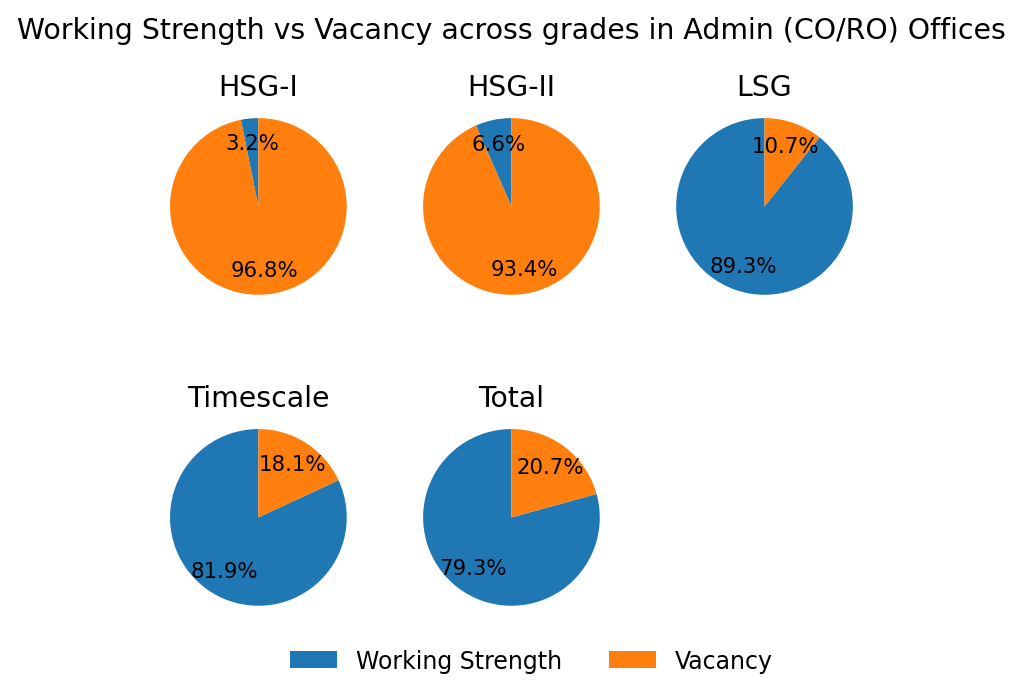
III. Pyramidal Cadre Structure: The hierarchy of posts must remain pyramidal in nature, with sufficient feeder grades to sustain promotional avenues. Disproportionate expansion at higher levels without adequate base support is discouraged.
IV. Financial Prudence: Ministries/Departments are responsible for furnishing realistic estimates of additional expenditure and demonstrating efficiency or service delivery gains commensurate with such costs.
V. Compliance with Rules and Recruitment Regulations: Any restructuring must remain consistent with notified Recruitment Rules, extant instructions of DoPT, and general principles governing cadre management.
6.5.2 Creation of Posts
The creation of posts is permissible only against clear functional requirements, duly justified by workload, organizational necessity, or new policy initiatives. Ministries/Departments must provide:
I. Details of sanctioned strength, working strength and vacancy position; II. Nature of duties to be performed in the proposed posts;
III. Impact on service delivery and efficiency; and
IV. Financial implications with indication of how matching savings are proposed. V. No creation of posts is permissible merely to absorb surplus staff.
54 No. 7(1)/E.Coord-I/2017 dated 05.01.2024 - Compendium of Instructions (DoE)
71
6.5.3 Abolition of Posts
Posts identified for abolition must be live posts. These are posts that exist in the sanctioned strength and are not deemed abolished under the orders of the Ministry of Finance relating to lapse of vacancies.
I. The abolition of such posts is essential when used as matching savings for creation or upgradation of posts.
II. Ministries/Departments must certify that posts proposed for abolition are functional, and not already deemed abolished.
6.5.4 Upgradation of Posts
Upgradation refers to the placement of an existing sanctioned post in a higher pay level.
I. This is to be justified by change in duties, responsibilities, or higher skill requirements of the post.
II. Upgradation cannot be sought solely on grounds of parity with other cadres or as a means to address stagnation, unless accompanied by functional rationale.
III. The number of upgraded posts should not disturb the pyramidal cadre structure.
6.5.5 Downgrading of Posts
The guidelines distinguish between permanent downgrading and temporary downgrading:
I. Permanent Downgrading
A. A post may be permanently downgraded (e.g., from a higher pay level to a lower one) only with the prior approval of the Department of Expenditure.
B. This is treated as a structural change and requires the same level of scrutiny as creation or abolition.
II. Temporary Downgrading
A. For administrative convenience, Ministries/Departments are empowered to order temporary downgrading of posts up to Group ‘B’ (Non-Gazetted) and Group ‘C’ cadres.
B. This is permitted where suitable officers are not available in the feeder grades to fill higher posts, or where immediate exigencies demand. C. Such downgrading is strictly temporary and does not alter the sanctioned strength or structure of the cadre. Once eligible incumbents become available, the posts must be restored to their original level.
6.5.6 Applicability to Group ‘B’ and Group ‘C’ Cadres
The guidelines explicitly empower Administrative Ministries/Departments to take decisions on temporary downgrading of posts in Group ‘B’ (Non-Gazetted) and Group ‘C’ cadres.
72
However, creation, abolition, upgradation, or permanent downgrading of such posts requires approval of the Department of Expenditure.
This distinction ensures that routine administrative adjustments can be managed internally, while structural or permanent changes are centrally regulated for consistency and financial control.
6.5.7 Conclusion
The DoE order of 05.01.202455 provides the binding framework for any cadre restructuring exercise. It emphasizes functional need, financial prudence, and maintenance of a balanced hierarchical structure. Importantly, while temporary downgrading in Group B and C posts can be exercised at the Ministry/Department level, all other actions — creation, abolition, upgradation, or permanent downgrading — are subject to the scrutiny and approval of the Department of Expenditure. Any recommendations of the Cadre Restructuring Committee must therefore be in strict conformity with these principles to ensure acceptance and implementation.
55 No. 7(1)/E.Coord-I/2017 dated 05.01.2024 - Compendium of Instructions (DoE)
73
6.6 Establishment Norms in Circle Office, Post Offices and Mail offices56
The Committee also examined the establishment norms governing supervisory posts in Circle Offices, Post Offices, and Mail Offices. Although these norms were framed several decades ago, they provide valuable insight into the administrative rationale and workload considerations of that period. The Committee reviewed them not for direct adoption, but to understand the underlying principles that guided the structuring of supervisory positions, so as to evolve recommendations that are relevant to present-day functional realities and adaptable to future operational requirements.
Circle Office:
For each Circle Office, one post of Office Superintendent is sanctioned. The total number of Head Clerks/Head Assistants (General) shall be equal to 10 percent of the clerical posts in the Circle Office, excluding leave reserve. The ratio of Head Clerks to HSG Head Assistants (General) shall be 9:1.
Post Offices:
When the number of Postal Assistants in a Post Office is five or more, supervisory work hours are to be calculated. In offices having 2 to 5 Lower Selection Grade (LSG) Supervisors, the Postmaster will be in the grade of Higher Selection Grade-II (HSG-II). When there are more than six LSG Supervisors, the Postmaster will be in the grade of Higher Selection Grade-I (HSG-I).
Railway Mail Service Offices:
When there are six Sorting Assistants, the sixth post is to be upgraded to Lower Selection Grade (LSG). When one more post is justified in addition to the strength of six Sorting Assistants, two posts of Time-Scale Sorting Assistants are to be sanctioned instead of one, and the LSG Head Sorting Assistant will be provided purely for supervisory work. When the total number of Sorting Assistants is nine or above, supervisory work hours are to be calculated department-wise. The post of Head Sorting Assistant is to be upgraded to Higher Selection Grade-II (HSG-II) if he supervises two to five LSG Supervisors in his own set.
These establishment norms, though dated, served as a useful reference for understanding the historical basis of supervisory structuring. The Committee’s recommendations, therefore, aim to retain the functional intent of these norms while aligning them with current operational dynamics and future organizational needs.
56 Establishment Norms for Supervisory Posts (CO/PO/RMS)
74
6.7 Recruitment Rules – Postal Assistants (PA) & Sorting Assistants (SA)57
Name of the Post | |
|---|---|
Postal Assistant (Post Office) | |
Postal Assistant (Circle Office and Regional Offices) | |
Sorting Assistant (Railway Mail Service) | |
| Level in the Pay Matrix | Level 4 (Rs. 25500 - 81100) in the Pay Matrix |
Eligibility (Selection) in General | |
| Age limit for Direct Recruits | I. Between 18 to 27 years for Direct Recruits other than GDSs II. Between 18 to 40 for GDSs III. (Relaxable subject to conditions) |
| Educational and Other Qualifications for Direct Recruits | I. Bachelor’s Degree from recognised university II. Knowledge of Computer |
| Period of Probation, if any | I. Two years for Direct Recruits subject to successful completion of ‘Induction Training’. |
| Method of Recruitment | 40 % through Promotion from eligible officials 60% through Direct Recruitment |
Table 6. Recruitment Rules of PA/SA Entry Grades in PO, RMS and CO/RO Offices
The revision of the Recruitment Rules in 2022, raising the minimum qualification for Postal Assistant and Sorting Assistant posts to a Bachelor’s degree, marks a forward-looking reform aligned with the Department’s evolving functional needs. With operations now spanning logistics, finance, and customer services in a digitally driven environment, this change ensures that new entrants possess the required digital competence, adaptability, and analytical skills. The Generation-Z workforce brings familiarity with technology and responsiveness to change, strengthening the Department’s ability to keep pace with a fast-evolving communications and logistics sector.
Further, the intent of the revised Recruitment Rules is to foster a symbiotic relationship: while the Department provides these officials with an environment that encourages growth, learning, and career progression (thus avoiding stagnation), the officials in turn push the organization towards quicker adoption of new technologies, processes, and customer-centric practices. This continuous exchange ensures that India Post evolves into a modern service provider, leveraging the dynamism of its workforce while offering them the opportunities to thrive and contribute meaningfully to departmental transformation.
57 F.No. 04-05/2015-SPN-I dated 20.06.2022 [RRs of PA & SA- Official Gazette of India, Extraordinary, Part-ll, Section 3, Sub-section (ii) vide GSR No. 459(E) on 17.06.2022.]
75
6.8 Recruitment Rules – HSG-I, HSG-II & LSG Grades
6.8.1 Higher Selection Grade-I in Post Offices & Railway Mail Service offices
As per the Revised Recruitment Rules, 201458 and the subsequent Amendment Rules, 201759, the post of Higher Selection Grade-I (HSG-I) in Post Offices and Railway Mail Service (RMS) Offices is classified as Group ‘B’ (Non-Gazetted), placed in Level-7 of the Pay Matrix. The mode of recruitment is by promotion, with eligibility restricted to HSG-II officials of the respective side (Postal or RMS) who have completed a minimum of five years of regular service in the feeder grade.
| Name of the Post | Higher Selection Grade-I in Post Offices |
|---|---|
| Classification | General Central Service, Group ‘B’, Non-Gazetted, Ministerial |
| Level in the Pay Matrix | Level 7 (44900 - 142400) in the Pay Matrix |
| Method of Recruitment | 100 % by Promotion |
| Feeder Grade | Higher Selection Grade-II in Post Offices |
| Period of Probation | Not Applicable |
| Eligibility | Five years of regular service in Feeder Grade |
Table 7. Recruitment Rules for HSG-I in Post Offices
| Name of the Post | Higher Selection Grade-I in Railway Mail Service Offices |
|---|---|
| Classification | General Central Service, Group ‘B’, Non-Gazetted, Ministerial |
| Level in the Pay Matrix | Level 7 (44900 - 142400) in the Pay Matrix |
| Method of Recruitment | 100 % by Promotion |
| Feeder Grade | Higher Selection Grade-II in RMS Offices |
| Period of Probation | Not Applicable |
| Eligibility | Five years of regular service in Feeder Grade |
Table 8. Recruitment Rules for HSG-I in Railway Mail Service Offices
| Name of the Post | Higher Selection Grade-I in Circle/Regional Offices |
|---|---|
| Classification | General Central Service, Group ‘B’, Non-Gazetted, Ministerial |
| Level in the Pay Matrix | Level 7 (44900 - 142400) in the Pay Matrix |
| Method of Recruitment | 100 % by Promotion |
| Feeder Grade | Higher Selection Grade-II in Circle/Regional Offices |
| Period of Probation | Not Applicable |
| Eligibility | Five years of regular service in Feeder Grade |
Table 9. Recruitment Rules for HSG-I in Circle/Regional Offices
58 F.No. 4-26/2009/SPB-II dated 27.08.2014 [Revised Recruitment Rules, 2014 for the post of Higher Selection Grade-I in Post Offices and Railway Mail Service Offices, -Official Gazette of India, Extraordinary, Part-ll, Section 3, Sub-section (i) vide GSR No. 509(E) on 17.07.2014.] 59 F.No. 20-41/2016-SPB-II dated 13.07.2017 [Amendment of Recruitment Rules, -Official Gazette of India, Extraordinary, Part-ll, Section 3, Sub-section (i) vide GSR No. 651(E) on 28.06.2017.]
76
6.8.2 Higher Selection Grade-II in Post Offices, Railway Mail Service Offices and Circle Offices/ Regional Offices
As per the Revised Recruitment Rules, 201360 and the subsequent Amendment Rules, 201761, the post of Higher Selection Grade-II (HSG-II) in Post Offices and Railway Mail Service (RMS) Offices and Circle Offices/Regional Offices is classified as Group ‘B’ (Non-Gazetted), placed in Level-6 of the Pay Matrix. The mode of recruitment is by promotion, with eligibility restricted to LSG officials of the respective side (Postal or RMS or Circle Office/ Regional Offices) who have completed a minimum of six years of regular service in the feeder grade.
| Name of the Post | Higher Selection Grade-II in Post Offices |
|---|---|
| Classification | General Central Service, Group ‘B’, Non-Gazetted, Ministerial |
| Level in the Pay Matrix | Level 6 (35400 - 112400) in the Pay Matrix |
| Method of Recruitment | 100 % by Promotion |
| Feeder Grade | Lower Selection Grade in Post offices |
| Eligibility | Six years of regular service in Feeder Grade |
Table 10. Recruitment Rules for HSG-II in Post Offices
| Name of the Post | Higher Selection Grade-II in Railway Mail Service Offices |
|---|---|
| Classification | General Central Service, Group ‘B’, Non-Gazetted, Ministerial |
| Level in the Pay Matrix | Level 6 (35400 - 112400) in the Pay Matrix |
| Method of Recruitment | 100 % by Promotion |
| Feeder Grade | Lower Selection Grade in Railway Mail Service offices |
| Eligibility | Six years of regular service in Feeder Grade |
Table 11. Recruitment Rules for HSG-II in Railway Mail Service Offices
| Name of the Post | Higher Selection Grade-II in Circle/Regional Offices |
|---|---|
| Classification | General Central Service, Group ‘B’, Non-Gazetted, Ministerial |
| Level in the Pay Matrix | Level 6 (35400 - 112400) in the Pay Matrix |
| Method of Recruitment | 100 % by Promotion |
| Feeder Grade | Lower Selection Grade in Circle Offices/ Regional Offices |
| Eligibility | Six years of regular service in Feeder Grade |
Table 12. Recruitment Rules for HSG-II in Circle/Regional Offices
60 F.No. 44-19/2009-SPB-II dated 01.01.2014 [Recruitment Rules, 2013 for the post of Higher Selection Grade-II in Post Offices (including Foreign Post Offices other than at Mumbai), Railway Mail Service Offices, Savings Bank Control Organization, Circle Office/Regional Offices, Returned Letter Offices, Foreign Posts at Mumbai and Independent Postal Stores in the Department of Posts- Official Gazette of India, Extraordinary, Part-ll, Section 3, Sub-section (i) vide GSR No. 746(E) on 22.11.2013.]
61 F.No. 20-41/2016-SPB-II dated 13.07.2017 [Amendment of Recruitment Rules, -Official Gazette of India, Extraordinary, Part-ll, Section 3, Sub-section (i) vide GSR No. 650(E) on 28.06.2017.]
77
6.8.3 Lower Selection Grade in Post Offices, Railway Mail Service Offices and Circle Offices/ Regional Offices
As per the Amended Revised Recruitment Rules, 201162 and the subsequent Amendment Rules, 201763, the post of Lower Selection Grade(LSG) in Post Offices and Railway Mail Service (RMS) Offices and Circle Offices/Regional Offices is classified as Group ‘C’ (Non-Gazetted), placed in Level-5 of the Pay Matrix. The mode of recruitment is by promotion, with eligibility restricted to Postal/Sorting Assistants of the respective side (Postal or RMS or Circle Office/ Regional Offices) who have completed a minimum of Five years of regular service in the feeder grade.
| Name of the Post | Lower Selection Grade in Post Offices |
|---|---|
| Classification | General Central Service, Group ‘C’, Non-Gazetted, Ministerial |
| Level in the Pay Matrix | Level 5 (29200 - 92300) in the Pay Matrix |
| Method of Recruitment | 100 % by Promotion |
| Feeder Grade | Postal Assistants in Post offices |
| Eligibility | Five years of regular service in Feeder Grade |
Table 13. Recruitment Rules for LSG in Post Offices
| Name of the Post | Lower Selection Grade in Railway Mail Service Offices |
|---|---|
| Classification | General Central Service, Group ‘C’, Non-Gazetted, Ministerial |
| Level in the Pay Matrix | Level 5 (29200 - 92300) in the Pay Matrix |
| Method of Recruitment | 100 % by Promotion |
| Feeder Grade | Sorting Assistants in Railway Mail Service offices |
| Eligibility | Five years of regular service in Feeder Grade |


Table 14. Recruitment Rules for LSG in Railway Mail Service Offices
| Name of the Post | Lower Selection Grade in Circle/Regional Offices |
|---|---|
| Classification | General Central Service, Group ‘C’, Non-Gazetted, Ministerial |
| Level in the Pay Matrix | Level 5 (29200 - 92300) in the Pay Matrix |
| Method of Recruitment | 100 % by Promotion |
| Feeder Grade | Postal Assistants in Circle Offices/ Regional Offices |
| Eligibility | Five years of regular service in Feeder Grade |
Table 15. Recruitment Rules for LSG in Circle/Regional Offices
62 F.No. 06-08/2010-SPB-II dated 02.01.2012 [Recruitment Rules, 2011 for the post of Lower Selection Grade in Post Offices, Railway Mail Service, Savings Bank Control Organization, Returned Letter Offices, Foreign Posts, Postal Stores Depot in the Department of Posts; Official Gazette of India, Extraordinary, Part-ll, Section 3, Sub-section (i) vide GSR No. 706(E) dated 21.09.2011 & GSR No. 62(E) on 31.01.2011.]
63 F.No. 20-41/2016-SPB-II dated 13.07.2017 [Amendment of Recruitment Rules, -Official Gazette of India, Extraordinary, Part-ll, Section 3, Sub-section (i) vide GSR No. 649(E) on 28.06.2017.]
78
An examination of the Recruitment Rules and subsequent amendments governing HSG-I, HSG-II, LSG and Postal Assistant/Sorting Assistant cadres reveals that the process of rationalisation across different functional units—such as Returned Letter Offices (RLOs), Postal Stores Depots (PSDs) and Foreign Post Offices—has been relatively gradual. Over time, there has been an evident attempt to bring about horizontal uniformity in the Recruitment Rules applicable to various units and grades, even though the feeder cadres for promotion continue to remain distinct.
The analysis shows that, while the nature of work may differ from one unit or office to another, the level of competencies, capacities and skill sets expected of officials at comparable grades is broadly similar across the Department. The key distinction lies not in the competency framework but in the specific experience acquired in the feeder grades—shaped by the type of office, the operational processes, and the functional exposure gained in those posts.
6.9 Study of Framework of Roles, Activities and Competencies for the PA and SA Cadres
To gain a comprehensive understanding of the duties and responsibilities across different supervisory levels, the Committee undertook an extensive study of the framework of roles, activities, and competencies pertaining to Postal Assistants/Sorting Assistants, LSG, HSG-II, and HSG-I officials in Post Offices (POs), Railway Mail Service (RMS) offices, and Circle/Regional Offices (CO/ROs). This study was aimed at clearly mapping the operational functions, supervisory requirements, and competency expectations at each grade, thereby establishing functional justification for cadre restructuring.
The Framework of Roles, Activities and Competencies (FRAC), issued by the Department of Personnel and Training (DoPT) in November 2020 and circulated vide Training Division Letter No. 01-67/2013-Trg. (Pt.) dated 21.01.2021, provides the responsibilities for various roles in Government. It sets out the guiding principles, common vocabulary, and structured steps to be followed for the pre-FRACing process under Mission Karmayogi. The framework enables Ministries and Departments to clearly understand job roles, associated activities, and required competencies, thereby ensuring role clarity, accountability, and capacity building across all levels of government.
79
6.9.1 FRAC for Postal Assistant (PO)64
In Post Offices, Postal Assistants (PAs) serve as the key interface between the customers and the Department of Posts, functioning as the public face of the organization. They work in diverse capacities across the country and play a crucial role in delivering postal services on behalf of the Government of India. The cadre also acts as a vital link between customers, field staff such as Gramin Dak Sevaks, MTS, and Postmen, and the administrative units, thereby ensuring that operations flow smoothly from service counters to back-end offices.
Nature of Work:
The work of Postal Assistants is broad and covers both customer-facing and office-support functions. Their responsibilities include handling mail-related services such as registered posts, parcels, and money orders, maintaining accurate accounting and bookkeeping records for transactions including sale of stamps, postal orders, and other services, and providing direct customer service as the first point of contact for queries, complaints, and requests. They also perform essential clerical work such as filing, typing, and maintaining registers and office records, ensuring compliance with departmental standards and transparency in service delivery.
Functional Significance:
Postal Assistants are central to the Department’s ability to deliver reliable and citizen-centric services. By ensuring accurate record keeping, prompt handling of customer needs, and efficient execution of both financial and non-financial transactions, they uphold service quality and accountability. Their work directly impacts customer satisfaction, operational efficiency, and the credibility of the Department of Posts as a service provider to the public. By bridging the operational and administrative sides of the organization, PAs contribute to both service delivery and systemic efficiency.
Range of Roles:
The Postal Assistant designation covers a wide spectrum of roles reflecting the varied functions of the Department. These include MPCM PA, Mails PA, Sorting PA, Delivery PA, Registration/Parcel/Speed Post PA, Treasurer, Savings Bank PA, Sub Accounts PA, Accounts PA, CPC (PLI) PA, Philately PA, SBCO PA, Foreign Post PA, and Office Assistant in Divisional Offices. Beyond these, PAs are also deployed as Trainers, Development Officers (PLI), System Administrators, and Business Post Centre (BPC) PAs, thus contributing not only to front-end service delivery but also to specialized, administrative, and business development functions. This diversity of roles underscores the PA’s importance as the backbone of the postal system.
64 FRACing for the cadre of Postal Assistant (Post Office) - PTC Mysuru
80